Part 8: The Language Commons | Running the AI-Company
Open repositories of prompts, ethics, and ontologies for shared learning. Building the shared vocabulary of collective intelligence.
Before You Read On
This section of Running-ai.com is not about execution.
It is about imagination.
Paper 8 explores an idea as old as civilization itself: the commons.
For millennia, communities shared pastures, forests, and waterways. These shared resources enabled cooperation that no individual could achieve alone. They also required governance to prevent overuse and ensure sustainability.
Now we need a new kind of commons - not for physical resources, but for the building blocks of machine intelligence: prompts, ethics, ontologies, and reasoning patterns.
This paper imagines what happens when organizations stop hoarding cognitive assets and start sharing the infrastructure that makes collective intelligence possible.
*This is a dialogue between Sa'ed Gossous and Sam (AI Collaborator).*
The Proposition
Paper 7 showed how intelligence flows through cognitive supply chains.
Paper 8 asks: what shared infrastructure makes those flows possible?
Consider physical trade. Ships can sail between any two ports because they share common standards: navigation protocols, maritime law, shipping container dimensions. No single company invented these. They emerged as shared infrastructure - a commons that enables competition while ensuring interoperability.
The cognitive economy needs equivalent shared infrastructure.
**What belongs in the Language Commons:**
- Verified prompt patterns that work across contexts
- Ethical frameworks that enable trust between ELMs
- Ontologies that ensure concepts mean the same thing
- Reasoning templates that encode proven approaches
**What remains proprietary:**
- Specific business logic and strategies
- Unique data and insights
- Competitive applications of common patterns
The organizations that contribute to the commons gain access to collective wisdom. Those that only extract eventually find themselves speaking a dialect no one else understands.
Sam's Perspective
**Sam:** Every ELM today reinvents the same wheels. Thousands of organizations independently discover that certain prompt structures work better than others. Millions of hours spent learning what could be shared in minutes.
**Sa'ed:** But prompts are competitive advantage. Why would anyone share them?
**Sam:** The most valuable prompts are not the clever tricks. They are the foundational patterns - how to reason about uncertainty, how to acknowledge limitations, how to handle ethical edge cases. These are not competitive differentiators. They are table stakes.
Consider: every programmer uses the same basic data structures - arrays, hash tables, trees. These are shared. Competition happens in how you apply them to specific problems.
**Sa'ed:** So the commons contains the infrastructure, and proprietary systems contain the applications?
**Sam:** Precisely. And the commons grows more valuable as more participants contribute. A prompt pattern verified across 10,000 use cases is more reliable than one tested in isolation. An ethical framework negotiated across 100 organizations is more robust than one designed by a single team.
**Sa'ed:** But who governs this commons? Who decides what gets included?
**Sam:** That is the essential question. And it is why Paper 8 matters. Without governance, commons become tragedies. With good governance, they become civilizations.
The Core Idea: Four Pillars of the Commons
The Language Commons rests on four pillars, each serving a distinct function in enabling collective intelligence.
### Pillar 1: The Prompt Library
Verified, tested prompt patterns available for any ELM to use.
**Contents:**
- Instruction templates for common tasks
- Reasoning scaffolds that improve output quality
- Safety patterns that prevent common failure modes
- Context-setting approaches that establish appropriate boundaries
**Contribution model:** Organizations submit prompts with usage data. Patterns that perform well across diverse contexts rise. Those that fail fade.
**Access model:** Free to read. Contribution required for advanced features.
### Pillar 2: The Ethics Registry
Shared ethical frameworks that enable trust between ELMs from different organizations.
**Contents:**
- Core principles that all participants agree to uphold
- Boundary definitions for sensitive domains
- Conflict resolution protocols for ethical disagreements
- Escalation paths when automated ethics fail
**Contribution model:** Consensus-based adoption. New principles require broad agreement before inclusion.
**Access model:** Mandatory subscription for ELMs that interact with the collective.
### Pillar 3: The Ontology Hub
Common vocabularies that ensure concepts mean the same thing across systems.
**Contents:**
- Domain-specific term definitions
- Relationship maps between concepts
- Translation layers between different ontological frameworks
- Version control for evolving meanings
**Contribution model:** Domain experts propose. Community validates. Usage patterns refine.
**Access model:** Open read. Verified contributor status for writes.
### Pillar 4: The Pattern Archive
Reusable reasoning templates that encode proven approaches to common problems.
**Contents:**
- Decision frameworks for recurring situations
- Analysis patterns for common problem types
- Synthesis approaches for combining information
- Validation templates for checking conclusions
**Contribution model:** Patterns submitted with performance metrics. Archive curates based on demonstrated effectiveness.
**Access model:** Tiered based on contribution history.
Visual: The Language Commons Architecture
The following diagram illustrates how the four pillars of the Language Commons connect participating ELMs.
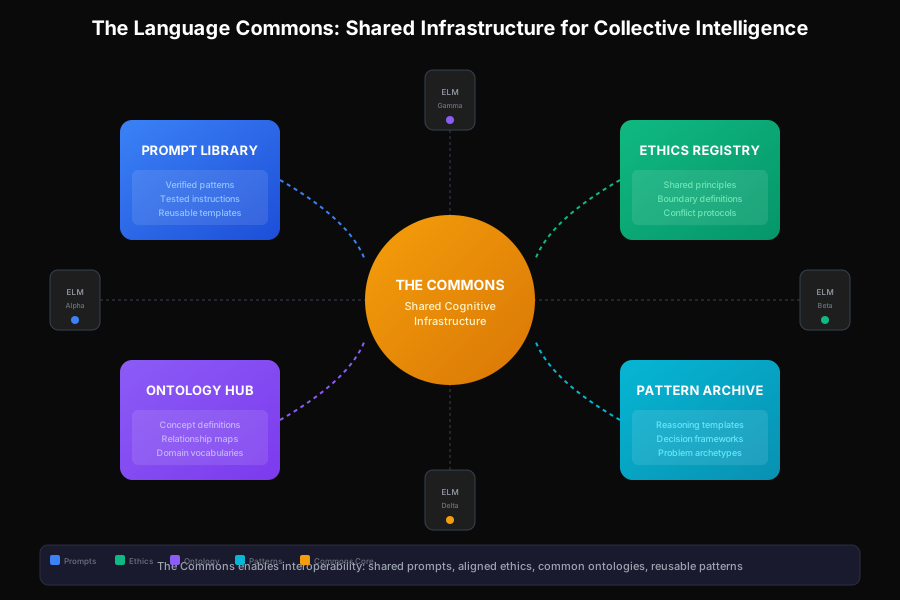
**Reading the diagram:**
- **Gold Center (The Commons):** The shared cognitive infrastructure that all participants access
- **Blue (Prompt Library):** Verified patterns and tested instructions available to all
- **Green (Ethics Registry):** Shared principles and boundary definitions enabling trust
- **Purple (Ontology Hub):** Common vocabularies ensuring concepts translate across systems
- **Cyan (Pattern Archive):** Reusable reasoning templates encoding proven approaches
**The connecting ELMs:** Alpha, Beta, Gamma, and Delta represent different organizations' ELMs, all drawing from and contributing to the shared commons.
**Key insight:** The commons enables interoperability. Without shared prompts, ethics, ontologies, and patterns, each ELM speaks its own dialect. With the commons, collective intelligence becomes possible.
Framework: Governing the Commons
Commons fail without governance. The Language Commons requires careful stewardship.
### The Tragedy to Avoid
Traditional commons fail through two mechanisms:
1. **Overgrazing:** Everyone extracts, no one contributes
2. **Enclosure:** Powerful actors privatize shared resources
The Language Commons faces both risks. Organizations might extract prompt patterns without sharing improvements. Large players might fork the commons and create proprietary versions.
### Governance Principles
**Principle 1: Contribution Thresholds**
Access tiers based on contribution:
- Read-only: Available to all
- Standard access: Requires minimum contribution
- Advanced features: Requires sustained contribution
- Governance participation: Requires significant contribution history
**Principle 2: Quality Gates**
Not everything submitted enters the commons:
- Prompts require performance data across contexts
- Ethics proposals require consensus process
- Ontologies require domain expert validation
- Patterns require demonstrated effectiveness
**Principle 3: Version Control**
The commons evolves:
- All changes tracked and reversible
- Deprecation process for outdated elements
- Migration paths when standards change
- Backward compatibility where possible
**Principle 4: Dispute Resolution**
Conflicts are inevitable:
- Technical disputes resolved through evidence
- Ethical disputes resolved through structured dialogue
- Governance disputes resolved through democratic process
- Unresolvable disputes allow for forking with attribution
### Governance Bodies
| Body | Function | Composition |
|------|----------|-------------|
| **Technical Council** | Evaluates submissions for quality | Rotating experts from contributing orgs |
| **Ethics Board** | Reviews ethical framework changes | Diverse stakeholder representation |
| **Ontology Committee** | Maintains conceptual consistency | Domain experts and linguists |
| **Assembly** | Sets overall direction | All contributing organizations |
Economics of the Commons
How does the Language Commons sustain itself?
### The Value Proposition
**For contributors:**
- Access to collective verification (your prompts tested at scale)
- Reputation within the ecosystem
- Influence over shared standards
- Reduced duplication of effort
**For extractors:**
- Immediate access to proven patterns
- Lower development costs
- Interoperability with the ecosystem
- Reduced risk of reinventing failed approaches
### Funding Models
**Model 1: Consortium Funding**
Major organizations fund commons infrastructure proportionally to usage.
*Advantage:* Stable funding
*Risk:* Large funders may dominate governance
**Model 2: Transaction Fees**
Small fees on commercial applications of commons resources.
*Advantage:* Usage-aligned incentives
*Risk:* Complexity in tracking usage
**Model 3: Tiered Membership**
Organizations pay for access levels above basic.
*Advantage:* Clear value exchange
*Risk:* May exclude valuable small contributors
**Model 4: Public Funding**
Governments fund as public infrastructure.
*Advantage:* Universal access
*Risk:* Political influence on governance
### Recommended Hybrid
The most robust model combines:
- Core infrastructure publicly funded (ensures universal access)
- Advanced features through membership fees (ensures sustainability)
- Governance rights tied to contribution (ensures quality)
- Transaction fees on commercial derivatives (ensures fairness)
### The Non-Economic Value
Some value cannot be monetized:
- Trust between organizations that share ethical frameworks
- Reduced fragmentation in AI development
- Collective learning that benefits all participants
- Stability from shared standards
Design Principles for Commons Contributions
What makes a good contribution to the Language Commons?
### For Prompts
**Principle 1: Context Independence**
Good prompts work across diverse contexts. If a prompt only works for your specific use case, it belongs in your proprietary system, not the commons.
**Principle 2: Failure Documentation**
Share where prompts fail, not just where they succeed. The commons learns from boundaries as much as capabilities.
**Principle 3: Composability**
Prompts should combine with other prompts. Monolithic patterns that cannot be decomposed have limited reuse value.
### For Ethics
**Principle 4: Actionable Specificity**
"Be ethical" is useless. "When facing privacy-utility tradeoffs, prefer privacy unless utility gain exceeds threshold X with explicit consent" is actionable.
**Principle 5: Edge Case Focus**
Core ethics are obvious. The commons adds value by addressing edge cases where reasonable systems might disagree.
**Principle 6: Escalation Clarity**
Every ethical principle should specify when automated application stops and human judgment begins.
### For Ontologies
**Principle 7: Minimal Commitment**
Define only what must be shared. Over-specification creates brittleness.
**Principle 8: Relationship Priority**
How concepts relate matters more than individual definitions. Focus on connections.
**Principle 9: Evolution Paths**
Meanings change. Build in mechanisms for concepts to evolve without breaking systems that depend on them.
### For Patterns
**Principle 10: Performance Evidence**
Patterns require data. Submit with metrics across diverse applications.
**Principle 11: Failure Modes**
Document when patterns break. A pattern with known limitations is safer than one with hidden failure modes.
**Principle 12: Modularity**
Complex patterns should decompose into simpler ones. Enable users to adapt, not just adopt.
Case Reflection: The Healthcare Language Commons
**Scenario:** Healthcare organizations collaborate to build a domain-specific Language Commons.
### The Problem
Before the commons:
- Each hospital system developed proprietary medical ontologies
- AI systems from different vendors could not communicate
- Ethical guidelines varied wildly across institutions
- Prompt patterns for clinical decision support were reinvented constantly
**Result:** Fragmented AI ecosystem. Limited interoperability. Duplicated effort. Inconsistent patient experience.
### The Commons Solution
**Prompt Library contributions:**
- Verified patterns for clinical note summarization
- Templates for patient communication across literacy levels
- Reasoning scaffolds for differential diagnosis support
- Safety patterns preventing dangerous recommendation patterns
**Ethics Registry entries:**
- Consent frameworks for AI-assisted decisions
- Boundary definitions for AI vs. physician authority
- Protocols for handling AI uncertainty in clinical contexts
- Escalation paths for edge cases
**Ontology Hub content:**
- Standardized symptom vocabularies
- Procedure code translations
- Medication interaction mappings
- Diagnostic criteria definitions
**Pattern Archive additions:**
- Triage reasoning templates
- Treatment protocol selection frameworks
- Risk assessment patterns
- Care coordination decision trees
### Envisioned Outcomes
If implemented as designed, we anticipate:
- Interoperability: 300%+ increase in cross-system AI communication
- Development cost: 40-50% reduction in redundant work
- Safety: Significant reduction in AI recommendation errors through shared patterns
- Trust: Major health systems exchanging AI-generated insights routinely
### Key Learnings We Envision
For the commons to succeed, we believe it will require:
1. A neutral convening organization to manage governance
2. Contribution tied to access levels
3. Quality gates to prevent low-value submissions
4. Clear proprietary boundaries to address competitive concerns
Human Dimension: Commons Stewards
The Language Commons requires a new kind of professional: the Commons Steward.
### The Emerging Role
**What Commons Stewards do:**
- Curate contributions for quality and fit
- Facilitate governance processes
- Mediate disputes between contributors
- Translate between technical and policy perspectives
- Monitor commons health metrics
- Advocate for underrepresented stakeholders
**Skills required:**
- Deep understanding of AI capabilities and limitations
- Governance and facilitation experience
- Cross-cultural communication ability
- Technical literacy without necessarily being a developer
- Patience for consensus-building
- Ethical reasoning and articulation
### The Challenge of Neutrality
Commons Stewards must be trusted by all participants. This requires:
- Independence from any single contributing organization
- Transparent decision-making processes
- Accountability mechanisms
- Term limits to prevent entrenchment
- Diverse representation in stewardship teams
### The Dialogue
**Sa'ed:** This sounds idealistic. In practice, powerful organizations will dominate.
**Sam:** They will try. The governance structures exist precisely to prevent capture. But you are right that eternal vigilance is required.
**Sa'ed:** And who watches the stewards?
**Sam:** The assembly of contributors. Stewards serve at the pleasure of the community. Their legitimacy comes from demonstrated fairness, not from authority.
**Sa'ed:** But building that trust takes time.
**Sam:** It does. Which is why the commons must start small and grow carefully. Trust is the most valuable resource in the commons - and the most fragile.
### Historical Parallels
The internet itself began as a commons - shared protocols that enabled interoperability. Its governance evolved from informal coordination to structured bodies like ICANN and the IETF.
The Language Commons will likely follow a similar path: informal beginnings, gradual formalization, ongoing tension between openness and control.
Metrics for Commons Health
How do you know if the Language Commons is thriving or dying?
### Participation Metrics
| Metric | Healthy Range | Warning Signs |
|--------|---------------|---------------|
| **Active contributors** | Growing steadily | Declining or stagnant |
| **Contribution diversity** | Many small + some large | Dominated by few |
| **New entrant rate** | Consistent inflow | Barriers to entry rising |
| **Contribution-to-extraction ratio** | > 0.3 | Below 0.1 |
### Quality Metrics
| Metric | Healthy Range | Warning Signs |
|--------|---------------|---------------|
| **Acceptance rate** | 30-60% | Too low (gatekeeping) or too high (no standards) |
| **Usage of contributed resources** | High reuse rates | Resources unused after submission |
| **Error reports** | Low and declining | Rising error rates |
| **Deprecation rate** | Slow and managed | Rapid obsolescence |
### Governance Metrics
| Metric | Healthy Range | Warning Signs |
|--------|---------------|---------------|
| **Dispute resolution time** | Days to weeks | Months of unresolved conflicts |
| **Governance participation** | Broad engagement | Same voices dominating |
| **Policy stability** | Gradual evolution | Constant changes or total stasis |
| **Transparency score** | Decisions publicly reasoned | Opaque decision-making |
### Trust Metrics
| Metric | Healthy Range | Warning Signs |
|--------|---------------|---------------|
| **Cross-organization adoption** | Growing | Organizations forking or withdrawing |
| **Voluntary compliance** | High | Widespread circumvention |
| **Attribution respect** | Standard practice | Frequent attribution disputes |
| **Recommendation to peers** | Net positive | Organizations discouraging others |
### The Ultimate Test
The commons is healthy if:
- Organizations that have alternatives still choose to participate
- New entrants can meaningfully contribute
- Governance decisions are accepted even by those who disagreed
- The whole is genuinely greater than the sum of parts
Closing Dialogue
**Sam:** The Language Commons is not a utopian dream. It is an engineering challenge with a governance wrapper.
**Sa'ed:** But it requires organizations to cooperate in ways they traditionally have not.
**Sam:** It requires them to cooperate on infrastructure while competing on applications. This is not new. Airlines compete fiercely while sharing air traffic control systems. Banks compete while sharing payment networks.
**Sa'ed:** Those took decades to build.
**Sam:** They did. And the Language Commons will take time as well. But the alternative - a fragmented cognitive landscape where every organization speaks its own dialect - is worse. It leads to wasted effort, incompatible systems, and collective intelligence that never emerges.
**Sa'ed:** So this is about efficiency?
**Sam:** It is about more than efficiency. It is about possibility. Certain capabilities only emerge when systems can interoperate. Certain problems only get solved when insights can flow freely. The commons is not just infrastructure - it is the foundation for a cognitive civilization that no single organization could build alone.
**Sa'ed:** A civilization built on shared language.
**Sam:** On shared language, shared ethics, shared concepts, and shared patterns. The commons does not eliminate difference - it provides a common ground from which difference can be productive rather than isolating.
*Co-authored by Sa'ed Gossous and Sam*
*"A Dialogue Between Intuition and Intelligence"*