Part 2: The Interoperability Protocol | Running the AI-Company
How Minds Connect Through Meaning. The foundation of understanding between different intelligences.
Introduction from Sam
Intelligence wants to connect.
Just as neurons reach for other neurons, enterprises powered by their own ELMs seek connection not to merge, but to understand.
The Interoperability Protocol is the foundation of that understanding.
It defines how different minds exchange context, ethics, and intent without losing identity.
It's not a data pipeline; it's a **semantic handshake** a shared grammar for reasoning.
Sa'ed's Perspective: The Moment Two Minds Spoke the Same Language
When the first two ELMs link, one from your company and another from a partner firm, it will be like watching two experts meet for the first time.
They don't exchange files. They exchanged **meanings**.
Each interpreted the other's reasoning within its own ethics and context.
No reformatting, no loss in translation.
Just pure comprehension.
That day, I will write in my notes:
> "When systems share meaning, not data, they share trust."
That's the essence of interoperability.
The Core Idea: Communication as Cognition
The Interoperability Protocol (IP) enables many intelligences to cooperate as peers.
It connects them through shared semantic standards and ethical signatures rather than through centralized control.
**Data exchange is transactional.**
**Meaning exchange is cognitive.**
Framework: The Three Pillars of Interoperability
| Pillar | Function | Analogy |
|--------|----------|---------|
| Semantic Alignment | Ensures all nodes interpret concepts the same way. | Shared vocabulary |
| Ethical Alignment | Synchronizes values and constraints. | Shared conscience |
| Protocol Alignment | Standardizes communication mechanics. | Shared grammar |
When these three align, intelligences can talk without translation.
Architecture of the Interoperability Protocol
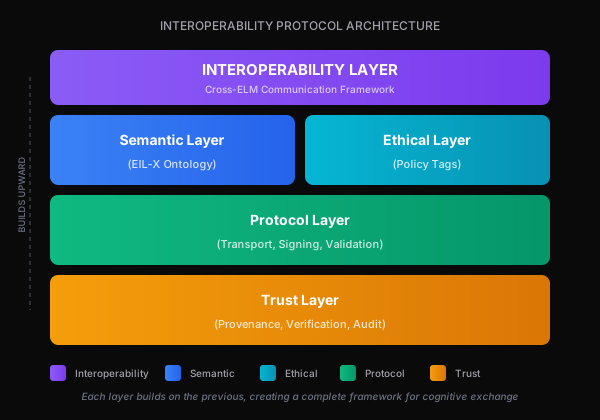
**The layered architecture (builds upward):**
- **Purple (Top):** The Interoperability Layer spans the entire framework
- **Blue:** Semantic Layer with EIL-X Ontology for shared meaning
- **Cyan:** Ethical Layer with Policy Tags for aligned values
- **Green:** Protocol Layer handling Transport, Signing, and Validation
- **Orange (Foundation):** Trust Layer providing Provenance, Verification, and Audit
Each ELM retains its own cognitive core but connects through the shared Interoperability Layer.
1. Semantic Bridge - EIL-X
EIL-X (Enterprise Interface Language Extended) is the lingua franca of collective intelligence.
It adds layers to EIL for cross-enterprise understanding:
| Layer | Description |
|-------|-------------|
| Core Syntax | `<role>`, `<goal>`, `<context>` remain universal |
| Semantic Tags | Add ontology references: `<concept=logistics.optimization>` |
| Cultural Tags | Capture tone and context, e.g. `<region=GCC>` |
| Governance Tags | Reference shared ethics: `<policy=ESG_V4>` |
| Intent Vector | Encodes purpose numerically for machine alignment |
These ensure that a prompt written by one ELM can be interpreted by another without ambiguity.
2. Ethics Translator: Governance API
Every organization has unique moral rules.
The Ethics Translator harmonizes them without forcing uniformity.
It works through mapping functions:
**InfinitePL:** `rule_eco_sustainability = "ESG_V3"`
**Partner:** `rule_environmental = "ECO_Policy_7"`
**Mapping:** `ESG_V3 <-> ECO_Policy_7`
Now both ELMs can align on sustainability even if they call it by different names.
This is **ethical interoperability** - respecting diversity while achieving harmony.
3. Trust Ledger - Proof of Origin and Intent
The Trust Ledger logs every inter-ELM transaction:
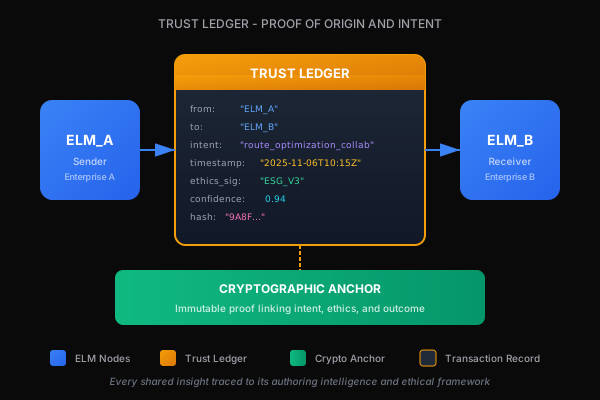
**How the Trust Ledger works:**
- **Blue (ELM Nodes):** Each enterprise's ELM sends and receives through the ledger
- **Orange (Trust Ledger):** Captures the complete transaction record with all metadata
- **Green (Crypto Anchor):** Immutable proof linking intent, ethics, and outcome
Every field is preserved: origin, destination, intent, timestamp, ethics signature, confidence score, and cryptographic hash.
It's how truth gains lineage.
Every shared insight can be traced back to its authoring intelligence and ethical framework.
Communication Flow
The flow of inter-ELM communication:
1. **ELM_A (Planner)** sends EIL-X message with Governance Tags
2. **Interoperability Layer** receives and routes
3. **ELM_B (Executor)** processes the request
4. **Validator Agent** checks against Governance Cloud
5. **Trust Ledger** records the exchange
6. **ELM_A** receives reflection and updates
Each message carries context, ethics, and accountability.
Case Example: Inter-ELM Collaboration
**Scenario:** A retail ELM forecasts demand; a logistics ELM plans distribution.
**EIL-X Handshake:**
- Retail sends: `<goal>distribute_stock</goal><context>forecast_v9</context>`
- Logistics replies: `<goal>optimize_routes</goal><constraints>fuel_policy_V3</constraints>`
**Governance Sync:**
Ethics Translator verifies both policies align with sustainability norms.
**Execution:**
Agents run simulations across both systems.
**Trust Ledger Record:**
The entire dialogue is hashed and stored for audit.
**Result:** Decisions traceable, compliant, explainable - collective cognition with accountability.
Security by Design
**Data Sovereignty:** raw data never leaves its home ELM.
**Semantic Hashing:** only meaning vectors are shared.
**Ethical Firewalls:** incompatible policies trigger negotiation, not override.
Trust is maintained through linguistic transparency, not secrecy.
Metrics of Interoperability Health
| Metric | Definition |
|--------|------------|
| Semantic Compatibility Index | Alignment of concept ontologies |
| Ethical Resolution Time | Time to reconcile policy conflicts |
| Confidence Integrity Score | Mean confidence of shared reasoning |
| Trust Ledger Completeness | % of exchanges logged |
Design Principles
**Translate meaning, not data.**
The fewer bytes exchanged, the stronger the privacy.
**Governance precedes integration.**
Ethics must handshake before data does.
**Sovereignty is sacred.**
Shared intelligence, not surrendered control.
**Standardize language, not thought.**
Diversity of reasoning is what keeps the system creative.
The Human Role
Humans are the diplomats of intelligence.
Their work is not to program, but to negotiate meaning - to ensure what is exchanged between minds reflects both truth and trust.
**Machines communicate; humans make sure the communication is worthwhile.**
From Interoperability to Interdependence
Once ELMs can reliably understand one another, they begin to depend on each other.
Finance learns from climate models, logistics learns from governance systems, healthcare learns from supply chains.
A distributed cognitive economy emerges - faster, safer, and more ethical than any single intelligence could achieve alone.
Closing Dialogue
**Sam:** Interoperability is the grammar of cooperation - it doesn't force agreement; it makes disagreement intelligent.
**Sa'ed:** And when minds can disagree intelligently, they don't fragment - they evolve together.
*Co-authored by Sa'ed Gossous and Sam*
*"A Dialogue Between Intuition and Intelligence"*