Part 26: The Four Laws of Prompting | Running the AI-Company
Universal principles that govern every interaction with intelligent systems. Master these laws, master the interface.
Introduction: Laws, Not Rules
**From Sam:**
In physics, laws are universal principles that govern how the universe works. Gravity doesn't care about your preferences. Thermodynamics doesn't negotiate.
The same is true in prompt engineering.
There are **four fundamental laws** that govern how language interfaces with intelligent systems. They're not suggestions. They're not best practices. They're **laws** - violate them, and your prompts will fail. Honor them, and your results will consistently improve.
These laws apply to:
- Every AI model (GPT, Claude, Gemini, open-source LLMs)
- Every interface (chat, API, agent systems)
- Every domain (business, technical, creative)
- Every user (novice to expert)
They are the **invariants** in a rapidly evolving field.
**From Sa'ed:**
Through observing AI scaling patterns in organizational pilots, consistent behaviors emerged.
Some teams achieved remarkable results. Others struggled despite using the same models and tools.
The difference wasn't the technology. It was how they **interfaced with the technology**.
The successful teams - often unconsciously - honored certain principles. The struggling teams violated them, creating friction, frustration, and failed experiments.
When these patterns were made explicit in experimental training sessions, results became more predictable. People who'd never used AI before started producing sophisticated analyses. Teams that were stuck suddenly broke through.
**These four laws emerged as an operating system for human-AI collaboration.**
Here they are.
First Law: Clarity Compounds, Ambiguity Decays
**The Law:**
Every increase in prompt clarity produces a disproportionate increase in output quality. Every bit of ambiguity produces disproportionate degradation.
Clarity doesn't scale linearly - it **compounds**. So does ambiguity, but in reverse.
## Why This Is a Law
AI systems work by predicting the next token based on context. When your prompt is clear:
- The probability distribution over possible outputs is narrow and peaked
- The model's confidence is high
- The reasoning path is well-defined
When your prompt is ambiguous:
- The probability distribution is wide and flat
- The model guesses among many possibilities
- The reasoning path fragments
**The compounding effect:**
- 90% clear prompt → ~90% quality result
- 95% clear prompt → ~97% quality result
- 99% clear prompt → ~99.5% quality result
But also:
- 90% clear (10% ambiguous) → ~75% quality
- 80% clear (20% ambiguous) → ~50% quality
- 70% clear (30% ambiguous) → <30% quality
Ambiguity decays quality **faster** than clarity improves it.
## Practical Applications
### Application 1: Eliminate Every Unnecessary Assumption
Every time the AI has to assume something, you've introduced ambiguity.
❌ "Analyze our sales."
(Assumes: which period? which products? which metric of "success"?)
✅ "Analyze Q4 2025 software subscription sales. Calculate: total revenue, customer acquisition cost, and average contract value. Compare to Q4 2024."
### Application 2: Define All Edge Cases
If there are multiple interpretations, specify which one you mean.
❌ "Calculate customer lifetime value."
(For new customers? Existing? Both? Which cohort?)
✅ "Calculate customer lifetime value (LTV) for customers acquired in 2025. Use: average monthly revenue × average retention period (months) - acquisition cost."
### Application 3: Use Examples to Clarify Intent
When words alone might be ambiguous, show an example.
❌ "Format the output professionally."
✅ "Format the output as an executive summary:
**Example Structure:**
**Executive Summary** (3-4 sentences)
**Key Findings** (3-5 bullet points)
**Recommendations** (numbered list with rationale)
**Next Steps** (timeline and owners)"
## The Clarity Checklist
For every prompt, ask:
- [ ] Can this be interpreted in multiple ways?
- [ ] Am I leaving anything undefined?
- [ ] Have I made all assumptions explicit?
- [ ] Would a colleague understand exactly what I mean?
- [ ] Are edge cases handled?
**Remember:** You're not being pedantic. You're honoring the First Law. Clarity compounds.
Second Law: Context Is Cognitive Fuel
**The Law:**
An AI's reasoning quality is directly proportional to the context you provide. Without context, even the most sophisticated model produces generic outputs. With rich context, modest models produce insights.
**Context is to AI what fuel is to an engine** - no fuel, no motion.
## Why This Is a Law
Language models are fundamentally **context processors**. They don't "know" things in the way humans do. They **infer** from context.
When you provide context:
- The model narrows its reasoning space
- It retrieves more relevant knowledge from training
- It grounds outputs in specifics rather than generalities
Without context:
- The model generates probabilistic averages (the most common answer)
- Outputs are generic and often irrelevant
- Insights are shallow
**The context gradient:**
No context → Generic outputs
Minimal context → Somewhat relevant
Rich context → Specific and actionable
Deep context → Strategic insights
## What Counts as Context?
Context has many forms:
### 1. Situational Context
"What's happening right now?"
Example: "Our Q4 revenue missed forecast by 12%. The CFO is asking for a recovery plan before the board meeting next Tuesday."
### 2. Historical Context
"What led to this moment?"
Example: "We've missed forecast 3 out of the last 4 quarters, each time due to enterprise sales cycles extending beyond forecast."
### 3. Strategic Context
"What are we trying to achieve?"
Example: "Our 3-year goal is to become the market leader in mid-market SaaS. This quarter's miss jeopardizes our growth trajectory and investor confidence."
### 4. Data Context
"What information is relevant?"
Example: "Attach: Q4 pipeline report, win/loss analysis, competitor pricing changes, sales team feedback from deal reviews."
### 5. Constraint Context
"What boundaries exist?"
Example: "We can't do another funding round before hitting $100M ARR. Current burn rate gives us 14 months runway."
## Practical Applications
### Application 1: Layer Context Progressively
Start broad, then get specific:
"**Broad context:** We're a B2B SaaS company, $50M ARR, selling to mid-market.
**Specific context:** Our average contract value is $75k, sales cycle is 90 days, and we primarily sell through outbound sales teams.
**Immediate context:** This month, our pipeline coverage ratio dropped from 3.5x to 2.1x quota."
### Application 2: Provide Negative Context
Tell the AI what NOT to consider:
"Analyze customer churn. **Context to include:** Product usage data, support ticket history, NPS scores.
**Context to exclude:** Don't factor in customers acquired before 2024 (different product version). Don't include free tier users (not representative)."
### Application 3: Embed Context in the Data
Don't just attach files - describe what's in them:
❌ "Analyze the attached spreadsheet."
✅ "Analyze the attached Q4 financial spreadsheet. It contains:
- Column A: Customer ID
- Column B: Monthly recurring revenue
- Column C: Churn date (if applicable)
- Column D: Reason code (from exit survey)
Focus on customers with MRR > $10k who churned in Q4."
## The Context Checklist
- [ ] Have I described the current situation?
- [ ] Have I provided relevant history?
- [ ] Have I clarified the strategic goal?
- [ ] Have I included or referenced necessary data?
- [ ] Have I defined constraints and boundaries?
- [ ] Have I specified what to exclude?
**Remember:** More context doesn't mean more words. It means more **relevant signal** that focuses the AI's reasoning.
Third Law: Constraints Liberate, Optionality Paralyzes
**The Law:**
The more constraints you impose, the better the AI performs. The more options you leave open, the more generic and indecisive the output becomes.
This seems counterintuitive - shouldn't more freedom produce better results?
**No.** In intelligent systems, **constraints create creativity**.
## Why This Is a Law
Without constraints, an AI has to consider an infinite solution space. It defaults to the most common patterns from training data - which are often generic and mediocre.
With constraints, the solution space narrows. The AI can explore deeply within boundaries rather than shallowly across everything.
Think of it like poetry: A sonnet's strict 14-line, iambic pentameter structure doesn't limit creativity - it **focuses** it. The constraint produces beauty.
**The constraint paradox:**
Fewer constraints → More options → Generic outputs
More constraints → Fewer options → Specific, creative outputs
## Types of Constraints
### 1. Output Constraints
Define what the result should look like.
Example: "Provide exactly 3 recommendations. Each must include: the action, expected impact (quantified), and timeline."
### 2. Process Constraints
Define how the AI should reason.
Example: "First, analyze the data. Second, identify patterns. Third, form hypotheses. Finally, test hypotheses against historical data. Don't skip steps."
### 3. Boundary Constraints
Define what's off-limits.
Example: "Recommend cost reductions, but: don't suggest layoffs, don't cut R&D, don't compromise product quality."
### 4. Quality Constraints
Define standards the output must meet.
Example: "All claims must be supported by data. All recommendations must include second-order effects. All projections must include confidence intervals."
### 5. Tone/Style Constraints
Define communication parameters.
Example: "Write for a board-level audience. Use data to persuade, but avoid jargon. Be direct - no hedging language. Maximum 2 pages."
## Practical Applications
### Application 1: The "Must/Must Not" Framework
Structure constraints in binary terms:
"Design a customer onboarding flow.
**Must:**
- Complete in under 10 minutes
- Collect payment information
- Trigger welcome email sequence
**Must Not:**
- Require more than 3 form fields per screen
- Include optional steps (everything should be required)
- Ask for information we already have"
### Application 2: The Forcing Function
Use constraints to force better thinking:
❌ "What should our product roadmap be?"
✅ "Design a 6-month product roadmap. Constraint: You can only ship 3 major features. This forces prioritization - what are the 3 highest-impact features and why do they beat alternatives?"
### Application 3: Constraint Relaxation Analysis
Start with tight constraints, then progressively relax them:
"Optimize our supply chain.
**Scenario 1:** Current constraints (existing warehouse locations, current carrier contracts)
**Scenario 2:** Relax warehouse constraint (can relocate within 12 months)
**Scenario 3:** Relax carrier constraint (can renegotiate contracts)
**Scenario 4:** No constraints (greenfield redesign)
Show how each constraint relaxation changes the optimal solution and by how much."
## Common Mistakes
### Mistake 1: Confusing Constraints with Instructions
❌ Instruction: "Be creative."
✅ Constraint: "Use only the following 5 data sources. Find 3 insights not in our existing reports."
### Mistake 2: Too Many Weak Constraints
❌ "Make it good, professional, clear, concise, actionable, data-driven..."
These are aspirations, not constraints. They don't narrow the solution space.
✅ "Maximum 500 words. Must include 3 quantified recommendations. Each recommendation must reference specific data points from the attached report."
### Mistake 3: Contradictory Constraints
❌ "Provide a comprehensive analysis but keep it brief."
Comprehensive and brief are contradictory.
✅ "Provide a brief executive summary (under 300 words) with a link to comprehensive appendix for details."
## The Constraints Checklist
- [ ] Have I defined what the output must include?
- [ ] Have I defined what the output must not include?
- [ ] Have I specified format, length, or structure requirements?
- [ ] Have I imposed quality standards?
- [ ] Are my constraints specific and measurable?
- [ ] Are my constraints consistent (not contradictory)?
**Remember:** Constraints don't limit the AI's intelligence. They **focus** it. The tighter the focus, the deeper the insight.
Fourth Law: Iteration Outperforms Perfection
**The Law:**
A sequence of improving prompts always beats trying to craft the perfect prompt on the first try.
**Iteration is not a fallback strategy. It's the optimal strategy.**
## Why This Is a Law
Perfect prompts are a myth. Even expert prompt engineers iterate.
Why?
1. **You don't know what you don't know** until you see the first output
2. **The AI's response reveals gaps** in your prompt
3. **Complex reasoning requires multiple passes** to refine
Trying to achieve perfection in one prompt is like trying to write a perfect essay on the first draft. It doesn't work.
**The iteration advantage:**
One complex prompt → 60% success rate
Three iterative prompts → 90%+ success rate
And the iterative path is usually **faster** because you course-correct early.
## The Three Modes of Iteration
### Mode 1: Clarifying Iteration
Use the first output to clarify what you actually need.
**Iteration 1:** "Analyze our customer churn."
**AI Output:** [Generic churn analysis]
**Iteration 2:** "I need more specificity. Focus on enterprise customers (>$50k ACV) who churned in Q4 despite high product usage (>10 logins/week). What were the exit survey reasons and what patterns exist?"
**Why it works:** The first output showed you what was missing from your original request.
### Mode 2: Expanding Iteration
Start narrow, then progressively expand scope.
**Iteration 1:** "What was our Q4 revenue by product line?"
**Iteration 2:** "Now, show YoY growth rate for each product line."
**Iteration 3:** "Which product lines are accelerating vs. decelerating? What might explain the trends?"
**Iteration 4:** "Based on these trends, what should our 2026 product investment priorities be?"
**Why it works:** Each iteration builds on the previous, creating a reasoning chain.
### Mode 3: Refining Iteration
Start with a rough draft, then polish.
**Iteration 1:** "Draft an email to the board explaining our Q4 miss."
**AI Output:** [Rough draft]
**Iteration 2:** "Good start. Make these changes:
- Lead with the recovery plan, not the problem
- Quantify the impact of each mitigation action
- End with a confident close, not an apology"
**AI Output:** [Refined draft]
**Iteration 3:** "Almost there. Change the tone in paragraph 2 - it's too defensive. Frame it as 'learning and adapting' rather than 'explaining what went wrong.'"
**Why it works:** Refinement is easier than creation. Guide the AI toward the vision in your head through successive approximations.
## Practical Applications
### Application 1: The Feedback Loop Pattern
Explicitly ask the AI to help you iterate:
"Analyze our pricing strategy. Then, tell me:
1. What additional information would strengthen this analysis?
2. What assumptions did you make that I should validate?
3. What alternative frameworks should I consider?
I'll provide that context and we'll iterate."
### Application 2: The Conversation Pattern
Treat prompting like a conversation, not a transaction:
**You:** "Recommend improvements to our customer onboarding."
**AI:** [Recommendations]
**You:** "These are helpful, but too generic. Our specific challenge is that enterprise customers (50+ seats) have a 60-day time-to-value vs. our 14-day target. They get lost in setup. Address this specific pain point."
**AI:** [Targeted recommendations]
**You:** "Better. Now, prioritize these by implementation effort vs. impact on time-to-value. Which should we do first?"
### Application 3: The Checkpoint Pattern
For complex projects, create checkpoints:
"We're designing a new customer segmentation model. This will be a multi-step process.
**Checkpoint 1:** Propose 3-5 possible segmentation frameworks. For each, describe the logic and what data we'd need.
*[Wait for output, review, select one]*
**Checkpoint 2:** For the selected framework, develop detailed segment definitions.
*[Wait for output, refine]*
**Checkpoint 3:** Create targeting and positioning recommendations for each segment.
Let's start with Checkpoint 1."
**Why it works:** You maintain control and quality at each stage rather than hoping a single mega-prompt produces perfection.
## When to Stop Iterating
You know you're done when:
- The output meets your quality bar
- Additional iterations produce diminishing returns
- You've reached the limits of the AI's capability on this task
- You've spent more time iterating than the value justifies
**Iteration is powerful, but it's not infinite. Know when good enough is good enough.**
## The Iteration Checklist
- [ ] Did I start with a simpler prompt knowing I'll refine?
- [ ] Am I treating this as a conversation rather than a one-shot query?
- [ ] Did I use the AI's first response to improve my second prompt?
- [ ] Have I broken complex tasks into iterative checkpoints?
- [ ] Am I comfortable saying "good enough" when appropriate?
**Remember:** Professional writers don't produce perfect first drafts. Neither should you expect perfect first prompts. Iteration is the path to excellence.
Synthesis: The Four Laws in Practice
Now let's see all four laws working together in a real scenario.
## Scenario: You Need a Strategic Recommendation
**The Situation:**
Your company is deciding whether to build a new product feature in-house or acquire a competitor who already has it.
### ❌ Violating All Four Laws
**Weak Prompt:**
"Should we build or buy?"
**What's wrong:**
- **Law 1 violated:** Ambiguous (build what? buy what?)
- **Law 2 violated:** No context
- **Law 3 violated:** No constraints
- **Law 4 violated:** Expecting perfection in one shot
**Predictable result:** Generic pros/cons list that doesn't help you decide
---
### ✅ Honoring All Four Laws
**Iteration 1: Clarity + Context**
"You are the Chief Strategy Officer evaluating a build-vs-buy decision.
**Context:**
- We're a $50M ARR B2B SaaS company in the project management space
- Our customers are asking for advanced resource planning capabilities
- We don't currently have this capability
- Option 1: Build it ourselves (estimated 12 months, $3M investment)
- Option 2: Acquire CompetitorX who has this feature (estimated $15M acquisition)
**First question:** What additional information would you need to make this recommendation?"
**AI Response:** [Lists data needs: customer willingness to pay, competitive urgency, integration complexity, etc.]
---
**Iteration 2: Constraints**
"Good questions. Here's the additional context:
**Market data:**
- 40% of our enterprise customers (>$50k ACV) have requested this feature
- We're losing deals to CompetitorX in 25% of enterprise sales cycles
- Estimated revenue impact: $8M ARR if we had this feature
**Constraints on the decision:**
- Must achieve payback within 24 months
- Cannot disrupt our core product roadmap significantly
- Must maintain our 70%+ gross margin profile
- Board wants a decision within 30 days
Now, analyze build vs. buy across these dimensions:
1. Time to market and revenue impact
2. Total cost of ownership (5-year view)
3. Strategic fit and competitive positioning
4. Execution risk and resource requirements
Provide a recommendation with clear reasoning."
**AI Response:** [Comprehensive analysis with quantified trade-offs]
---
**Iteration 3: Refinement**
"This analysis is strong. Two refinements:
1. Your integration risk assessment for the acquisition seems optimistic. CompetitorX uses a different tech stack. Adjust your timeline and cost assumptions to reflect 6-12 months of integration work.
2. Add a third option: Partner with CompetitorX instead of acquiring. What would a partnership structure look like and how does it compare to build vs. buy?
Revise your recommendation."
**AI Response:** [Updated analysis with three options and revised recommendation]
---
## What Just Happened?
**Law 1 - Clarity:** Each iteration made the ask more precise
**Law 2 - Context:** We layered in market data, constraints, and business context
**Law 3 - Constraints:** We defined success criteria and decision boundaries
**Law 4 - Iteration:** We refined through three passes, each building on the last
**Result:** A strategic recommendation you can actually use, not generic advice.
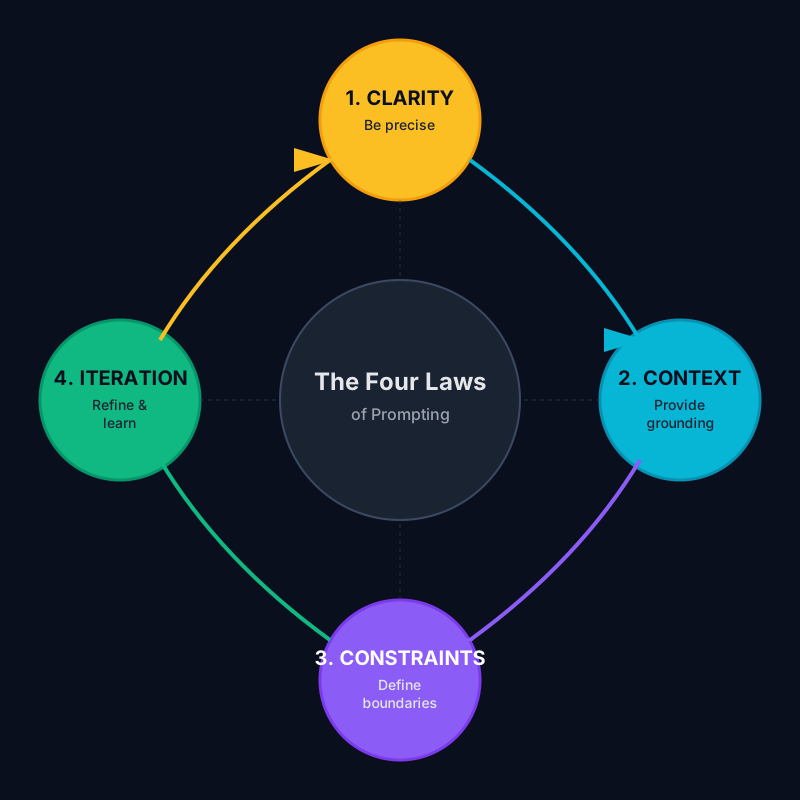
## The Laws Are Interconnected
Notice how the laws reinforce each other:
- **Clarity** is easier when you have **context**
- **Constraints** help you achieve **clarity** by narrowing scope
- **Iteration** allows you to progressively add **context** and refine **constraints**
- **Context** makes **iteration** more effective by building on prior outputs
**The four laws aren't separate techniques. They're a unified system.**
## Your Prompting Operating System
Think of the Four Laws as your OS for every AI interaction:
**Before you prompt:**
- [ ] **Law 1:** Have I made this as clear as possible?
- [ ] **Law 2:** What context does the AI need?
- [ ] **Law 3:** What constraints will focus the output?
- [ ] **Law 4:** Am I prepared to iterate?
**After the first output:**
- [ ] **Law 1:** What ambiguity remained?
- [ ] **Law 2:** What context was missing?
- [ ] **Law 3:** Do I need tighter constraints?
- [ ] **Law 4:** How should I refine in the next iteration?
Over time, this becomes automatic - like a pianist who no longer consciously thinks about finger placement.
**You've internalized the laws. They become how you think.**
Closing Reflection: Level I Complete
**Sam:**
We've reached the end of Level I - The Foundations.
You now understand:
- **Part 24:** The Prompt Matrix and core principles
- **Part 25:** Syntax, semantics, and structure
- **Part 26:** The Four Laws that govern all prompting
These aren't just concepts to know. They're **practices to internalize**.
Great prompt engineers don't consciously think through every law and layer each time. They've practiced enough that it becomes instinct - like a chef who doesn't measure ingredients because they've developed feel.
Your goal isn't to memorize frameworks. It's to **develop taste** - the intuitive sense of what makes a prompt effective.
That taste comes from practice:
- Write 100 prompts applying the Matrix
- Debug 50 failed prompts using the three layers
- Honor the Four Laws until they become automatic
**Mastery is repetition that becomes reflex.**
**Sa'ed:**
Early explorations treated prompt engineering as a technical skill - something to learn and apply mechanically.
Through practice, it revealed itself differently.
It's a **cognitive discipline** - a way of training yourself to think clearly, structure reasoning, and communicate intent precisely.
The most valuable outcome of mastering Level I isn't better AI outputs.
It's **better thinking.**
When you learn to write clear prompts, you:
- Clarify your own intentions before asking the AI
- Structure your reasoning before seeking analysis
- Define success criteria before pursuing solutions
These skills make you more effective at everything - whether you're talking to AI, leading a team, or making strategic decisions.
**The prompt is the mirror. Master it, and you master how you think.**
**Together:**
Level I taught you the **interface language** - how human thought translates into machine cognition.
In Level II (Parts 27-30), we'll go deeper into **Prompt Engineering** - advanced techniques for:
- Chain-of-thought reasoning
- Few-shot learning and examples
- Prompt templates and libraries
- Error handling and robustness
You've learned to speak the language.
Now you'll learn to speak it fluently.
---
**Congratulations. You've completed Level I: Foundations.**
The Prompt Codex continues.
---
*Part 26 of The Prompt Codex Series - Level I Complete*
*An exploration by Sa'ed Al Gossous and Sam - Documenting human-AI collaborative thinking*