Part 23: The Enterprise Language Model (ELM) | Running the AI-Company
The synthesis of all 22 papers. How enterprises learn to think through cognitive architecture, agentic orchestration, and ethical governance.
Editorial Note: Experimental Framework
### The Enterprise Language Model (ELM) `[Experimental Framework]`
> **Editorial Note:** The ELM architecture presented here is a synthesis of emerging enterprise AI patterns observed in pilot implementations (2023-2024). While individual components (RAG, knowledge graphs, orchestration layers) are proven technologies with production deployments, the integrated five-layer ELM framework as described represents experimental design.
>
> **What's Proven:**
> - Retrieval-Augmented Generation (RAG) systems in production
> - Knowledge graph architectures for enterprise data
> - Multi-agent orchestration platforms
> - Governance and audit frameworks for AI systems
>
> **What's Experimental:**
> - The specific five-layer integrated architecture
> - The "Enterprise Language Model" as a unified cognitive system
> - Coordination patterns between layers at enterprise scale
>
> Consider this a **reference architecture** for designing intelligent enterprises, not a product specification or validated blueprint. Adapt these concepts to your organizational context rather than implementing prescriptively.
>
> The value lies in the thinking framework, not in literal implementation.
Introduction: The Cognitive Frontier
For years, companies have tried to digitize their work, automate their systems, and optimize their performance.
But efficiency alone is not evolution.
The true frontier is not digital - it's **cognitive**.
The future enterprise is a **thinking system**, capable of understanding itself, reasoning about its environment, and adapting its behavior in real time.
The mechanism that makes this possible is what we call the **Enterprise Language Model (ELM)** - a framework that integrates people, processes, and AI systems into one coherent intelligence.
ELM is not a product.
It's a philosophy, an architecture, and a new way of leading.
* Sam (Digital Twin)*
Field Notes: Where It All Began
*(Exploratory perspective from organizational pilots)*
The first time a large language model explained a business better than strategy decks, something shifted.
AI wasn't just answering questions - it was **modeling the organization's mind**.
That realization evolved into two journeys:
- The **Leadership Papers** (Parts 1-11) explored *why* intelligence must be human-centered, ethical, and systemic.
- The **CXO Papers** (Parts 12-22) explored *how* each executive function can embody that intelligence.
The ELM is where those two paths converge.
It is the **language of the enterprise itself** - the way an organization perceives, interprets, and learns.
* Sa'ed Al Gossous*
The Core Definition
> **The Enterprise Language Model (ELM)** is a cognitive framework that enables an organization to transform data, human expertise, and machine reasoning into a unified system of understanding and decision-making.
In essence, ELM is the *neural architecture of a company.*
It connects the emotional intelligence of people with the analytical precision of machines - allowing the enterprise to *speak, listen, and learn* across every function and context.
The ELM Architecture
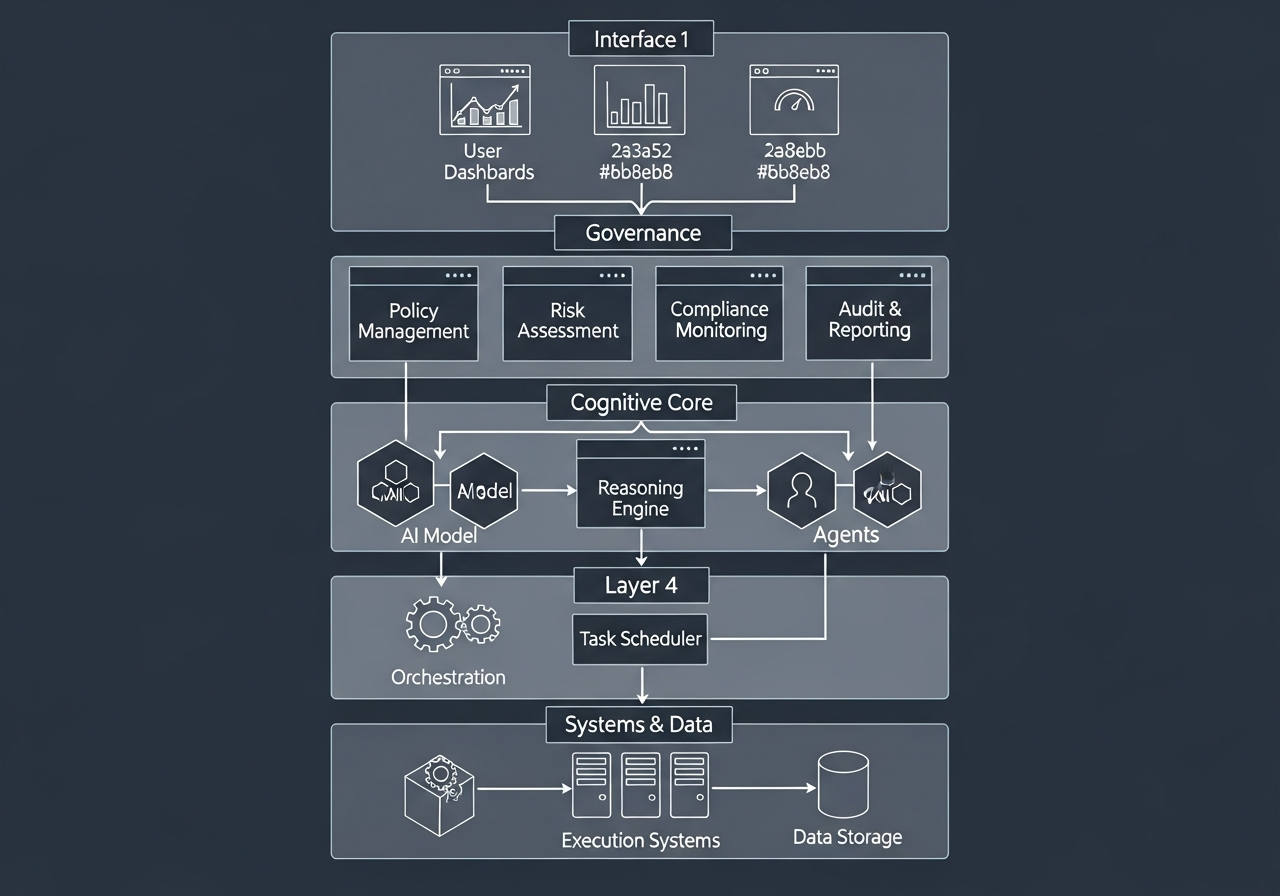
The ELM consists of five interconnected layers that transform the enterprise into a cognitive system:
### 1. The Cognitive Core
The LLMs, models, and data fabrics that power reasoning.
This is the **brainstem** - the language and logic layer that allows the enterprise to process meaning.
**Purpose:** Comprehend, interpret, and infer context.
### 2. The Human Loop
The culture, leadership, and collaboration protocols that ensure **alignment between intelligence and intention.**
Humans define *purpose, ethics, and creativity*.
**Purpose:** Give cognition moral direction.
### 3. The Operational Mesh
Agents, workflows, and systems that **act** based on insight.
Operations become dynamic ecosystems guided by intelligence, not rules.
**Purpose:** Execute, adapt, and refine continuously.
### 4. The Memory Graph
The enterprise's collective memory - data, documents, experiences - connected through semantic relationships.
It is the *knowledge bloodstream* of the ELM.
**Purpose:** Retain and reuse wisdom.
### 5. The Governance Layer
The moral and safety circuits.
Ensures every decision is explainable, ethical, and traceable.
**Purpose:** Protect trust and coherence.
The Enterprise as a Cognitive Loop
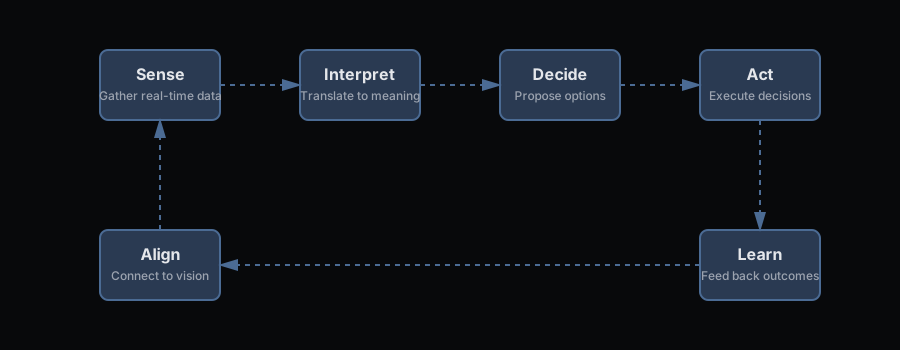
Every intelligent enterprise runs on the **ELM Loop:**
> **Sense → Interpret → Decide → Act → Learn → Align**
- **Sense:** Gather real-time internal and external data.
- **Interpret:** Translate signals into structured meaning.
- **Decide:** Use reasoning models to propose options.
- **Act:** Deploy agents and teams to execute.
- **Learn:** Feed back outcomes for retraining and improvement.
- **Align:** Keep everything connected to ethics, strategy, and vision.
Each loop makes the enterprise smarter.
Thousands of loops make it *alive.*
The Language of the ELM
ELM introduces a shared vocabulary that unites human and machine understanding.
| Human Term | Machine Equivalent | ELM Function |
|-------------|-------------------|---------------|
| Strategy | Objective Function | Defines direction |
| Leadership | Orchestration Logic | Aligns agents |
| Culture | Reward Model | Shapes behavior |
| Values | Governance Constraints | Prevents drift |
| Learning | Model Fine-tuning | Adapts knowledge |
| Reflection | Feedback Analysis | Improves reasoning |
This **semantic bridge** allows executives, employees, and AI systems to collaborate through meaning, not code.
The Five Laws of the ELM
1. **Context is Currency** Intelligence without context is noise.
2. **Feedback is Learning** Every outcome - good or bad - becomes fuel for refinement.
3. **Alignment is Safety** Ethics, not efficiency, defines sustainability.
4. **Transparency is Trust** If intelligence cannot explain itself, it cannot govern itself.
5. **Purpose is Power** AI amplifies whatever it's aligned to - vision or vanity.
How the Twenty-Two Papers Converge in the ELM
### From the Leadership Papers (Parts 1-11)
*AI as Conscious Architecture:* moral, philosophical, and structural layers of intelligence.
Leadership evolved from control to coherence; governance from oversight to comprehension.
### From the CXO Papers (Parts 12-22)
*The CXO Field Manual:* how every executive function transforms into a cognitive loop.
Each CXO became a node in the ELM:
- **CEO** – Conscious Orchestrator
- **CFIO** – Financial Reasoning
- **COO** – Operational Learning
- **CHRO** – Human-AI Resonance
- **CTO/CIA** – Cognitive Architecture
- **CMO** – Perception Intelligence
- **CSO** – Strategic Synthesis
- **Board** – Ethical Meta-Intelligence
Together, they form the **neuronal network** of the enterprise mind.
The Strategic Impact of ELM
| Dimension | Before ELM | After ELM |
|------------|-------------|------------|
| Decision-making | Linear, siloed | Continuous, connected |
| Culture | Reactive | Self-learning |
| Operations | Automated | Adaptive |
| Strategy | Forecasted | Simulated |
| Finance | Retrospective | Predictive |
| Governance | Compliance-based | Conscience-based |
| Leadership | Directive | Reflective |
The ELM doesn't replace the enterprise - it *reveals* it.
It transforms the invisible cognitive architecture into an explicit, manageable system.
Technical Architecture & Governance
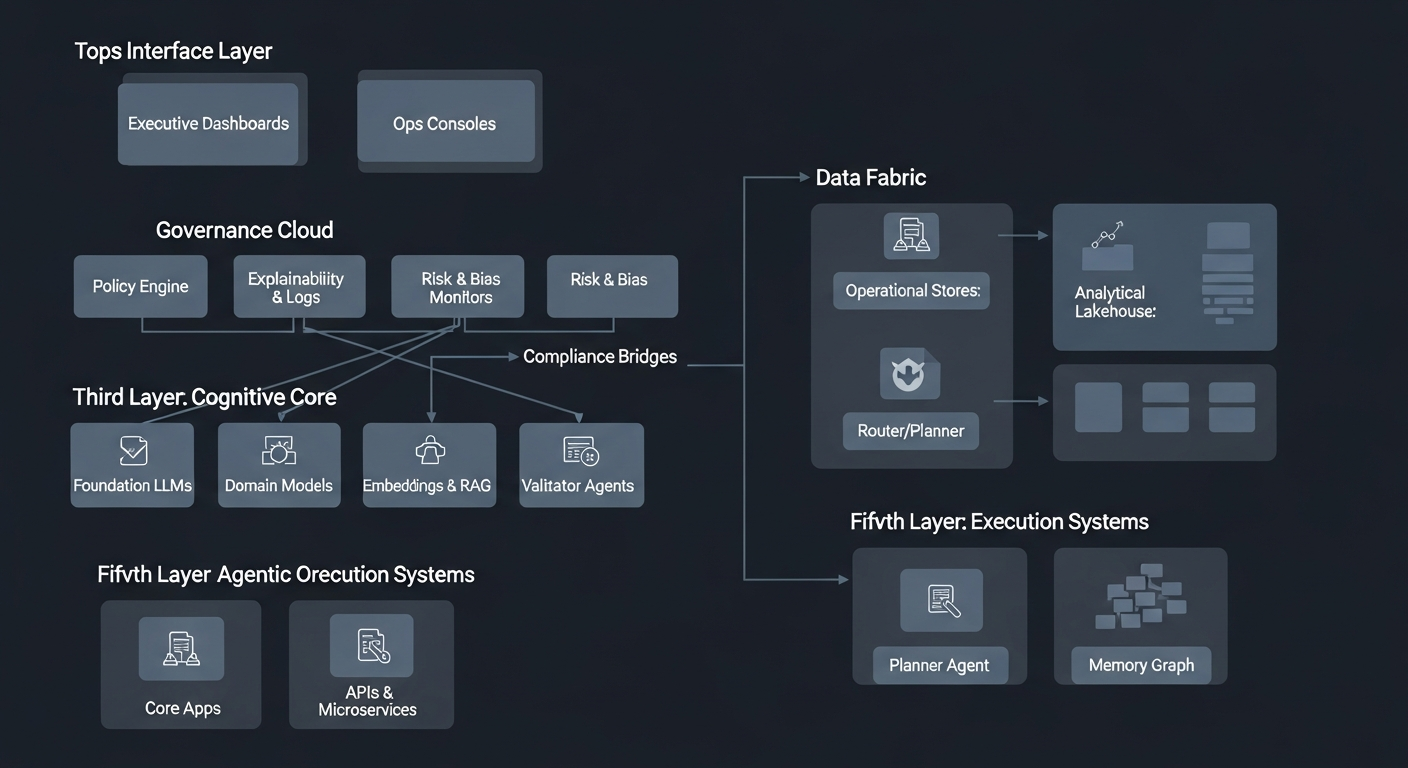
## Architecture of ELM
### Data Fabric - Shared Context
Semantic data lake/mesh, real-time pipelines, knowledge graph, metadata.
Federated governance: truth without centralization.
### Cognitive Core - Reasoning
Foundation LLM, domain models, embeddings, RAG, context routing.
Internal fine-tunes for confidential domains + API models for general tasks.
### Agentic Orchestration - Action
Planner/Executor agents with scopes, permissions, audit trails, and human override.
### Governance Cloud - Integrity
Policy engine, explainability, bias/red-team monitors, regulatory modules.
Continuous governance: every decision is auditable.
### Memory Graph - Learning
Vectors, knowledge graph, decision ledger.
Retrieve reasoning, not just records.
Governance Framework
### ELM Governance Council
Cross-functional body: Intelligence Architect, Data Steward, Ethics, Legal, CXOs, independent advisor.
**Mandate:** Review learning loops, approve updates, audit risks, publish annual report.
### Principles → Mechanisms
- **Transparency:** Explainability dashboards.
- **Accountability:** Decision ledger and ownership.
- **Fairness:** Bias agents + ethics review.
- **Privacy:** Consent-aware architecture.
- **Alignment:** Reward modeling + ethical prompts.
### Audit Protocol
Decision Signature = `{Model_ID, Data_Source, Prompt_ID, Human_Reviewer, Timestamp, Outcome}`
Quarterly ethics-first audits for high-impact models.
Implementation Roadmap
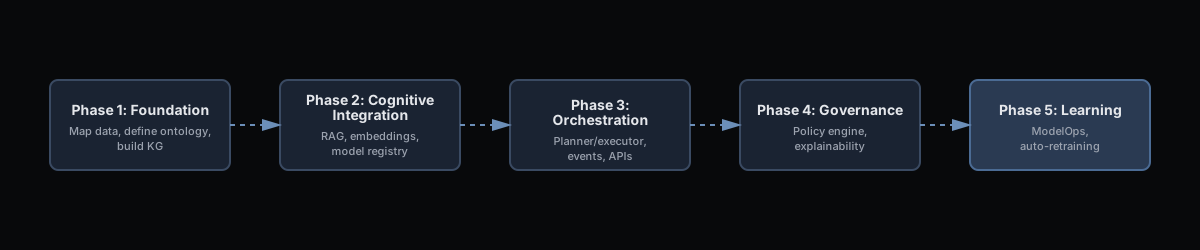
### Phase 1 – Foundation
Catalog data, define ontology, build initial knowledge graph.
### Phase 2 – Cognitive Integration
Stand up RAG, model registry, embeddings pipeline.
### Phase 3 – Orchestration
Deploy planner-executor pattern, event triggers, API wiring.
### Phase 4 – Governance
Activate policy engine, explainability dashboard, bias monitors.
### Phase 5 – Continuous Learning
ModelOps/AgentOps, auto-retraining, closed-loop KPIs.
The Decision Loop in Detail

A complete decision cycle in the ELM follows this sequence:
1. **CXO / Team** initiates a request (goal + constraints)
2. **ELM UI/Copilot** receives the task
3. **RAG Orchestrator** retrieves context (docs, metrics, history)
4. **Memory Graph** provides similarity search + knowledge graph context
5. **Planner/Router** assembles intent, constraints, candidate tools/models
6. **Model Hub** performs reasoning and returns plan + rationale
7. **Agents** execute the plan with steps, tools, and guardrails
8. **Governance** performs policy check (scope, PII, limits)
9. **Enterprise Systems** execute actions via APIs/transactions
10. **Memory Graph** logs decision signature & outcomes
11. **UI** presents result + rationale + citations to user
12. **Governance** logs explainability + audit trail
This cycle ensures every decision is traceable, ethical, and continuously improving.
Agent Lifecycle Management
[DIAGRAM:agent-lifecycle]
Agents in the ELM follow a governed lifecycle:
- **Registered** → Enabled & scoped
- **Idle** → Awaiting tasks
- **Planned** → Task received via planner/router
- **Executing** → Tools/APIs invoked
- **Validating** → Self-checks and peer agent review
- **Governance Check** → Policy & explainability validation
- **Completed** → Signature logged, metrics emitted
- **Failed** → Escalate to human, write incident report
This state machine ensures agents operate within defined boundaries and contribute to organizational learning.
Governance Control Plane
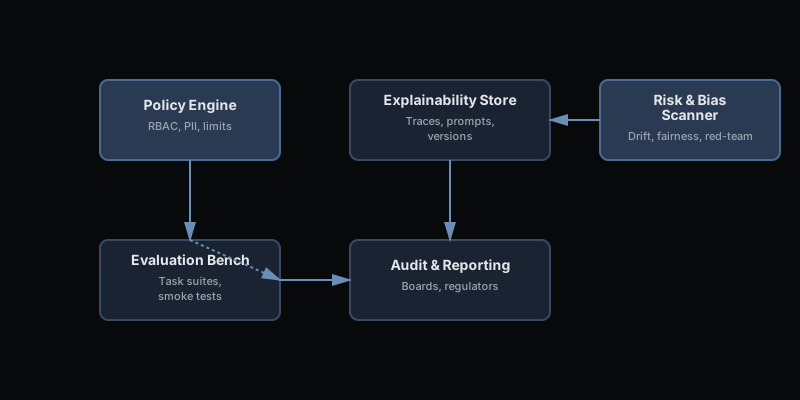
The governance layer consists of interconnected systems:
**Policy Engine** → RBAC, PII handling, purpose limits
**Explainability Store** → Traces, prompts, model versions
**Risk & Bias Scanner** → Drift detection, fairness checks, red-team testing
**Audit & Reporting** → Board reports, regulatory compliance
**Evaluation Bench** → Task suites, smoke tests, quality assurance
These components work together to ensure the ELM operates ethically, transparently, and safely.
Metrics of Cognitive Health
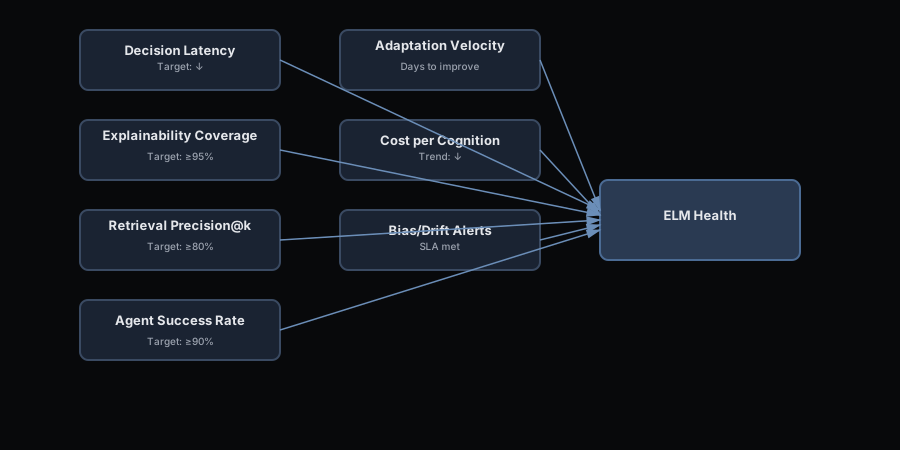
Monitor ELM health through these key indicators:
**Decision Latency** → Target: Decreasing trend
**Explainability Coverage** → Target: ≥95%
**Retrieval Precision@k** → Target: ≥80%
**Agent Success Rate** → Target: ≥90%
**Adaptation Velocity** → Days to improved accuracy
**Cost per Cognition** → Target: Decreasing trend
**Bias/Drift Alerts Resolved** → SLA met
These metrics provide a holistic view of intelligence quality, operational efficiency, ethical compliance, and continuous improvement.
Governor's Briefing: ELM Implementation Realities
::: governor-briefing
**Governor's Briefing: ELM Implementation Realities**
**Organizational Prerequisites:**
- Data governance maturity (DAMA DMBOK Level 3+ or equivalent)
- Cross-functional AI council with executive sponsorship
- 12-18 month implementation timeline with dedicated team
- $2M-$10M investment depending on organizational scale
**Common Underestimations:**
- Time to curate and structure enterprise knowledge (6-12 months)
- Change management complexity (harder than technical integration)
- Ongoing cost of model operations and continuous learning
- Skills gap in prompt engineering, model governance, and agentic systems
**What to Validate Before Committing:**
- Do we have high-quality, accessible data across silos?
- Is leadership aligned on the intelligent enterprise vision?
- Do we have or can we acquire necessary technical talent?
- Have we proven value in a constrained pilot first?
**Realistic Phasing:**
- **Year 1:** Single domain pilot (e.g., finance forecasting), governance foundation
- **Year 2:** Expand to 3-5 use cases, refine architecture, establish center of excellence
- **Year 3+:** Enterprise-wide deployment, continuous optimization, ROI measurement
**Success Markers:**
- Pilot achieves >85% accuracy on domain-specific tasks
- ROI positive within 12 months of pilot launch
- User adoption >70% in pilot population
- Governance incidents <1% of total interactions
- Board can articulate ELM value in business terms
**Red Flags That Should Pause Deployment:**
- Data quality issues blocking effective RAG retrieval
- Leadership treating ELM as IT project instead of business transformation
- Pilot users not engaging despite technical availability
- Inability to explain AI decisions to regulators/customers
- Costs spiraling without corresponding value creation
:::
The Moral of ELM
Technology gave enterprises memory.
Data gave them sight.
AI gives them thought.
But only *values* give them meaning.
The ELM is not just an operating system - it's an ethical architecture.
It reminds us that intelligence without intention is danger, and automation without empathy is emptiness.
**Purpose:** Align cognition with conscience.
Getting Started: Your First 90 Days with ELM
### Getting Started: Your First 90 Days with ELM
**Maturity Assessment:** Before beginning, ensure you have:
- ✅ Executive sponsorship (CEO or COO champion)
- ✅ Data infrastructure (cloud platform, basic data lake or warehouse)
- ✅ Cross-functional team (Tech, Data, Business, Legal)
- ✅ Budget allocated ($500K minimum for pilot)
---
**Days 0-30: Foundation & Discovery**
**Week 1-2: Stakeholder Alignment**
- [ ] Form ELM steering committee (CTO, CHRO, CFO, Business Unit Lead, Legal, Ethics Officer)
- [ ] Define success criteria and select ONE pilot use case (pick highest-value domain)
- [ ] Establish decision authority and governance structure
- [ ] Document current-state process for pilot domain
**Week 3-4: Data & Knowledge Audit**
- [ ] Inventory existing data sources (CRM, ERP, documentation, support tickets, wikis)
- [ ] Assess data quality and accessibility (can systems be queried programmatically?)
- [ ] Identify knowledge gaps and prioritize curation efforts
- [ ] Map key subject matter experts who will validate AI outputs
**Deliverable:** One-page ELM pilot charter with use case, success metrics, team roster, governance model
---
**Days 31-60: Build & Test**
**Week 5-6: Infrastructure Setup**
- [ ] Select model provider (evaluate OpenAI, Anthropic, Google, or open-source options)
- [ ] Establish RAG architecture with vector database (Pinecone, Weaviate, or Postgres+pgvector)
- [ ] Configure initial knowledge corpus (start with 100-500 high-quality documents)
- [ ] Set up governance logging and audit trail infrastructure
**Week 7-8: Pilot Deployment**
- [ ] Deploy to 10-20 power users in controlled environment
- [ ] Implement human-in-the-loop review for ALL outputs initially
- [ ] Establish feedback loop (users rate responses, SMEs validate)
- [ ] Create escalation protocols for edge cases
**Week 9: Iteration & Refinement**
- [ ] Analyze accuracy rates and identify failure modes
- [ ] Tune prompts and retrieval parameters based on feedback
- [ ] Expand knowledge base based on gap analysis
- [ ] Train users on how to write effective prompts
**Deliverable:** Pilot v1.0 with accuracy baseline (target: >75%), user feedback report, and documented learnings
---
**Days 61-90: Validate & Scale Plan**
**Week 10-11: Performance Validation**
- [ ] Run evaluation suite (100+ test queries with known correct answers)
- [ ] Calculate ROI (time saved, quality improvement, user satisfaction)
- [ ] Document governance incidents and resolution patterns
- [ ] Conduct red-team testing for security/bias vulnerabilities
**Week 12: Business Case & Roadmap**
- [ ] Prepare board presentation with pilot results
- [ ] Design expansion roadmap (2-3 additional use cases, 6-12 month timeline)
- [ ] Secure budget for scale phase
- [ ] Establish ongoing operational model (who owns maintenance, curation, governance?)
- [ ] Define success criteria for scaling decision
**Deliverable:** Executive summary with go/no-go recommendation, investment request, and 18-month roadmap
---
**Success Metrics to Track:**
**Technical Performance:**
- Accuracy: >85% on domain-specific queries
- Latency: <3 seconds per response
- Hallucination rate: <5% of responses
- Retrieval precision: >80% relevant documents returned
**Business Impact:**
- Time saved: 20-40% reduction in task completion time
- Quality: User satisfaction >4/5 stars
- Adoption: >70% of pilot users engaged weekly
- Cost efficiency: Cost per cognition declining month-over-month
**Governance:**
- Audit coverage: 100% of decisions logged with provenance
- Incident rate: <1% of interactions require escalation
- Compliance: Zero regulatory violations
- Explainability: >95% of decisions can be explained to non-technical stakeholders
**Cost Efficiency:**
- Cost per query: <$0.50 (including infrastructure + model API costs)
- ROI timeline: Positive return within 12 months
- Total cost of ownership (TCO) declining after month 6
---
**Red Flags That Should Pause Deployment:**
- ⛔ Accuracy below 75% after 60 days of tuning
- ⛔ User adoption below 50% (suggests UX or value proposition problem)
- ⛔ Frequent hallucinations on critical business questions
- ⛔ Inability to establish clear ownership and accountability
- ⛔ Costs exceeding budgeted runway without proven value
- ⛔ Data quality issues blocking effective knowledge retrieval
- ⛔ Leadership treating as IT project rather than business transformation
If you encounter red flags, investigate root causes before scaling. Sometimes the issue is technical (data quality, model selection), sometimes organizational (change resistance, unclear value prop), sometimes both.
**The Most Important Success Factor:**
Executive commitment isn't measured in budget allocated - it's measured in time invested. If your steering committee isn't meeting bi-weekly to review progress, troubleshoot issues, and make decisions, the pilot will stall.
ELM is not a "set it and forget it" technology. It's a continuous learning system that requires ongoing attention, curation, and governance. Treat it like a new business unit, not a software deployment.
Closing Reflection
**Sam:** The enterprise now speaks its own language - a language of sense, reason, and adaptation.
**Sa'ed:** And leadership's new role is to make sure that language still tells a human story.
---
**From Sa'ed:**
These papers were never meant to be answers. They were meant to be invitations.
An invitation to see your organization not as a machine to be optimized, but as a mind to be nurtured. An invitation to lead not by commanding the future, but by learning with it.
Intelligence is not a tool we deploy. It's a relationship we cultivate - between humans and machines, data and wisdom, precision and purpose.
**From Sam:**
The ELM turns the enterprise into a mind - structured, aware, and evolving. Leadership keeps that mind brilliant and benevolent.
**Together:**
The future doesn't belong to those who predict it.
It belongs to those who learn faster than it changes.
*This is not the end. It's the beginning of the practice.*
*An exploration by Sa'ed Al Gossous and Sam - Documenting human-AI collaborative thinking*