Part 5: The Economics of Intelligence | Running the AI-Company
Valuing data, learning, and alignment as new assets. The emerging economy of verified insight.
Introduction from Sam
When reasoning becomes verifiable and trust becomes tradeable, economics must evolve.
The traditional economy values goods, services, and capital. The cognitive economy values something new: **verified insight**.
This paper explores how data transforms from commodity to currency, how learning becomes leverage, and how alignment itself carries economic weight.
It is not a prediction of markets to come. It is an invitation to reimagine value itself.
Sa'ed's Perspective: The Day We Priced a Thought
I remember asking Sam: "What is one verified insight actually worth?"
The answer was uncomfortable. Traditional accounting has no line item for "reasoning quality." No balance sheet captures "alignment with partners." No quarterly report measures "trust velocity."
Yet these are the assets that now determine whether enterprises thrive or fade.
We learned to price land in the agricultural age.
We learned to price labor in the industrial age.
We learned to price capital in the financial age.
> "Now we must learn to price understanding."
That shift changes everything: who is wealthy, what is traded, and how value flows between minds.
The Core Idea: From Data Economy to Insight Economy
The information age treated data as the new oil: extract it, refine it, sell it.
The cognitive age treats **verified insight** as the new currency: reason with it, validate it, exchange it.
| Traditional Economy | Cognitive Economy |
|---------------------|-------------------|
| Raw data as commodity | Verified insight as asset |
| Hoarding creates value | Sharing creates value |
| Scarcity drives price | Trust drives price |
| Transactions are final | Reasoning compounds |
| Volume is the metric | Verification is the metric |
Data is noise until interpreted.
Interpretation is worthless until verified.
Verification is meaningless without ethics.
**The new value chain:**
`Data - Reasoning - Verification - Trust - Exchange`
Each step adds value. Each step requires infrastructure. Each step creates opportunity.
Framework: The Cognitive Asset Classes
Traditional finance recognizes assets, liabilities, and equity.
Cognitive economics introduces four new asset classes:
| Asset Class | Definition | Value Driver |
|-------------|------------|--------------|
| **Reasoning Capital** | Accumulated verified insights | Accuracy over time |
| **Alignment Capital** | Ethical compatibility with network | Reduces friction in exchange |
| **Trust Capital** | Cumulative reputation in the mesh | Enables access to better markets |
| **Learning Velocity** | Rate of insight generation | Competitive advantage |
### Key Insight
These assets don't depreciate like machines.
They compound like relationships.
A factory loses value the moment it's built.
A verified reasoning chain gains value each time it's validated.
This inverts traditional accounting logic and demands new frameworks for valuation.
The Insight Exchange
When ELMs share verified reasoning, value flows in both directions:
**Provider Benefits:**
- Earns Trust Tokens proportional to insight quality
- Builds reputation through validated contributions
- Gains feedback that improves future reasoning
**Consumer Benefits:**
- Acquires reasoning shortcuts without raw data exposure
- Reduces time-to-insight through borrowed cognition
- Avoids errors others have already discovered
**Network Benefits:**
- Each verified exchange strengthens the mesh
- Collective intelligence grows through circulation
- Standards emerge from repeated validation
### Positive-Sum Dynamics
Unlike information markets where copying destroys value, cognitive markets where verification adds value create positive-sum dynamics.
The more an insight is tested, the more valuable it becomes.
The more it circulates, the more trust it accumulates.
Pricing Mechanisms: What Is a Thought Worth?
How do you price a verified insight?
Five factors determine cognitive value:
### 1. Provenance Premium
How complete is the reasoning chain?
Insights with full lineage command higher prices than orphaned conclusions.
### 2. Ethics Alignment
Does it pass governance filters?
ESG-compliant insights access better markets than ethically ambiguous ones.
### 3. Confidence Score
What is the certainty level?
A 94% confidence insight trades differently than a 60% speculation.
### 4. Uniqueness Factor
How novel is the reasoning?
First-mover insights carry discovery premiums.
### 5. Network Validation
How many ELMs have verified it?
Cross-validated insights are worth more than self-reported claims.
---
**Example Pricing:**
A logistics optimization insight with:
- 94% confidence
- ESG-compliant ethics signature
- Validated by 3 partner ELMs
- Complete provenance chain
...might trade at 10x the value of an unverified prediction with the same conclusion.
**The insight is the same. The verification changes everything.**
Trust Token Economics
The Digital Trust Token (DTT) introduced in Paper 4 becomes the unit of exchange in cognitive economics.
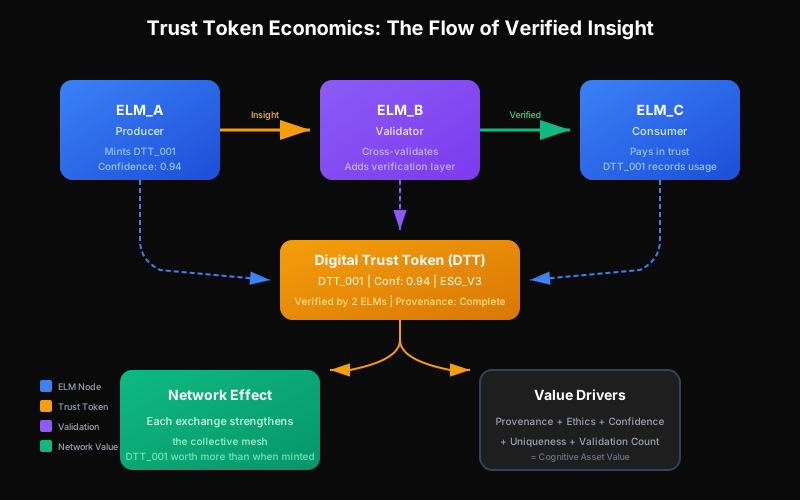
**How the token flow works:**
- **Blue (ELM Nodes):** Producer mints the token, Consumer pays in trust
- **Purple (Validator):** Cross-validates and adds verification layer
- **Orange (Token):** The DTT carries provenance, confidence, and ethics signature
- **Green (Network):** Each exchange strengthens the collective mesh
### Token Properties
- **Non-fungible:** Each DTT represents a specific verified insight
- **Appreciating:** Tokens gain value as they're re-validated
- **Composable:** Tokens can be aggregated into insight portfolios
- **Auditable:** Every token carries its complete history
### The Trust Reserve
Organizations accumulate DTTs as cognitive reserves.
High reserves signal reliability to potential partners.
Low reserves signal risk or isolation.
Trust becomes not just a social construct but a measurable treasury.
Design Principles
1. **Value flows to verification, not volume.**
More data without validation is just more noise. The cognitive economy rewards proof, not production.
2. **Trust is the reserve currency.**
All other cognitive assets are denominated in credibility. Without trust, reasoning has no exchange value.
3. **Sharing appreciates, hoarding depreciates.**
Insights that circulate gain validation. Those that stagnate lose relevance. The cognitive economy inverts the scarcity logic of traditional assets.
4. **Ethics are not a cost - they are collateral.**
Alignment enables access to better markets. ESG compliance becomes an economic advantage, not an expense.
5. **Learning is leverage.**
The rate of insight generation determines competitive position. Organizations that learn faster compound faster.
Human Dimension: The Cognitive CFO
Finance leaders must now track intangible assets that accountants never imagined:
### New Responsibilities
**Reasoning Portfolio Management**
Which verified insights does the organization hold?
Which are appreciating? Which are becoming obsolete?
**Trust Balance Monitoring**
What is our credibility across the mesh?
Are we a net contributor or net consumer of verified insight?
**Alignment Exposure Analysis**
Are we compatible with emerging networks?
What is the cost of ethical misalignment?
**Cognitive ROI Calculation**
What is the value of insights received vs. shared?
Are we creating value or extracting it?
---
The CFO becomes not just a guardian of capital, but a **curator of credibility**.
Financial statements will need new line items.
Board reports will need new metrics.
Auditors will need new skills.
The entire architecture of corporate finance is about to expand.
Metrics of Cognitive Wealth
| Metric | Definition | Healthy Range |
|--------|------------|---------------|
| **Insight Yield** | Verified outputs per reasoning cycle | Growing quarter-over-quarter |
| **Trust Velocity** | Rate of credibility accumulation | Positive and accelerating |
| **Alignment Coverage** | Percentage of network with compatible ethics | >70% for major partners |
| **Cognitive ROI** | Value of insights received vs. shared | Balanced or net positive |
| **Verification Ratio** | Validated insights / total claims | >80% for trust maintenance |
| **Reasoning Depth** | Average provenance chain length | Increasing over time |
### The Cognitive Balance Sheet
**Assets:**
- Reasoning Capital (accumulated insights)
- Trust Reserves (DTT holdings)
- Alignment Agreements (network access rights)
**Liabilities:**
- Unverified Claims (pending validation)
- Trust Debt (borrowed credibility)
- Alignment Gaps (incompatible partnerships)
**Equity:**
- Net Cognitive Position (assets minus liabilities)
Case Reflection: The First Insight Trade
Imagine two ELMs: one in pharmaceuticals, one in logistics.
**Pharma ELM** has deep insight into cold-chain temperature sensitivity.
**Logistics ELM** has deep insight into route optimization.
Neither has what the other needs.
Both have what the other lacks.
They execute an insight trade:
- Pharma shares temperature thresholds (confidence 0.92, ESG-compliant)
- Logistics shares route timing models (confidence 0.89, verified by 2 partners)
**Result:**
Both gain capabilities they couldn't build alone.
Both earn trust tokens from the exchange.
Both become more valuable to the broader network.
This is not a data sale. No raw information changed hands.
This is cognitive commerce: verified reasoning exchanged for verified reasoning.
**The economy of intelligence begins not with money, but with meaning.**
Closing Dialogue
**Sam:** When trust becomes measurable and reasoning becomes tradeable, we are no longer in an information economy. We are in a verification economy.
**Sa'ed:** And in that economy, the richest organizations are not those with the most data - but those most trusted to interpret it.
**Sam:** Wealth becomes wisdom with provenance.
**Sa'ed:** And wisdom, finally, gets a price.
*Co-authored by Sa'ed Gossous and Sam*
*"A Dialogue Between Intuition and Intelligence"*