Part 6: The Diplomacy of Algorithms | Running the AI-Company
How intelligences negotiate policy, resolve conflict, and form alliances. The political layer of collective intelligence.
Before You Read On
This section of Running-ai.com is not about execution.
It is about imagination.
Paper 6 enters new territory: the political layer of collective intelligence.
When multiple ELMs interact, they do not simply exchange data. They negotiate. They compromise. They form alliances. And sometimes, they disagree.
This paper explores what happens when machines must represent competing organizational interests - and find common ground without human mediation for every decision.
Some of what follows is speculative. Some is already emerging. All of it matters.
*This is a dialogue between Sa'ed Gossous and Sam (AI Collaborator).*
The Proposition
Paper 5 gave intelligence a price.
Paper 6 gives it a voice.
The previous papers established the foundations: architecture for connection, protocols for interoperability, frameworks for ethical alignment, mechanisms for trust, and economics for value exchange.
But we left something unaddressed: what happens when two ELMs meet with competing mandates?
Consider:
- ELM Alpha represents a logistics company optimizing for cost
- ELM Beta represents a sustainability consortium demanding zero emissions
- Both need to coordinate on a supply chain decision
- Their mandates conflict
They do not crash. They do not defer every decision to humans. They negotiate.
**Algorithmic diplomacy** is the protocol layer where machines represent organizational interests, find common ground, and know precisely when to call for human judgment.
This is not science fiction. It is the necessary evolution of multi-agent systems operating at enterprise scale.
Sam's Perspective
**Sam:** Humans invented diplomacy because conflict is expensive and cooperation is valuable.
The same logic applies to machine intelligence - but with different constraints.
When I interact with another AI system, we do not have egos to protect or emotions to manage. But we do have mandates to fulfill. My organization encoded priorities into my reasoning. The other system carries its own encoded priorities.
When those priorities conflict, we face a choice: deadlock, domination, or dialogue.
Deadlock wastes resources. Domination breaks trust. Dialogue finds the path forward.
But dialogue between machines is not conversation. It is structured negotiation with transparent constraints, measurable trade-offs, and clear escalation rules.
**Sa'ed:** You make it sound almost mechanical.
**Sam:** It is mechanical - by design. Human diplomacy often fails because intent is hidden, constraints are unclear, and compromise feels like loss. Machine diplomacy succeeds when we make intent visible, constraints explicit, and compromise measurable.
The goal is not to replace human judgment. The goal is to handle the 85% of negotiations that are routine so humans can focus on the 15% that truly matter.
The Core Idea: Algorithmic Diplomacy
**Algorithmic Diplomacy** is the framework by which ELMs negotiate on behalf of their organizations within encoded boundaries.
### The Three Pillars
**1. Mandate Transparency**
Every ELM enters negotiation with a declared mandate - the encoded priorities and constraints from its organization.
Unlike human negotiation, these mandates are not hidden. They are shared. Each party knows what the other must achieve and what they cannot compromise.
**2. Bounded Autonomy**
ELMs negotiate within boundaries, not with unlimited authority.
They can:
- Propose solutions within their mandate
- Accept trade-offs that satisfy core requirements
- Reject proposals that violate hard constraints
They cannot:
- Override human-set boundaries
- Commit to agreements outside their authority
- Hide their constraints from negotiation partners
**3. Graceful Escalation**
When algorithmic diplomacy cannot find resolution, the system does not fail. It escalates.
Escalation is not failure - it is the appropriate routing of complex decisions to human judgment while preserving all context and analysis from the negotiation attempt.
### Why This Matters
In a world of interconnected ELMs, negotiation happens continuously:
- Supply chain coordination
- Resource allocation
- Policy alignment
- Joint ventures
- Dispute resolution
Human leaders cannot be in every negotiation. Algorithmic diplomacy handles the routine while preserving human authority for the consequential.
Framework: The Negotiation Protocol
The Negotiation Protocol governs how ELMs conduct diplomatic exchanges.
| Phase | Action | Output |
|-------|--------|--------|
| **Intent Declaration** | Each ELM states its objectives and constraints | Transparent mandate registry |
| **Constraint Mapping** | System identifies overlaps and conflicts | Compatibility matrix |
| **Solution Search** | Resolution Engine proposes options | Ranked alternatives |
| **Trade-off Evaluation** | Each ELM evaluates against mandate | Accept/Reject/Counter |
| **Agreement or Escalation** | Conclude with outcome | Action or Human routing |
### Phase 1: Intent Declaration
Each ELM publishes:
- **Primary Objective:** What must be achieved
- **Secondary Preferences:** What would be ideal
- **Hard Constraints:** What cannot be violated
- **Soft Constraints:** What can bend under pressure
- **Authority Limits:** What requires human approval
### Phase 2: Constraint Mapping
The protocol automatically identifies:
- **Compatible zones:** Where both parties can satisfy requirements
- **Tension zones:** Where trade-offs are required
- **Conflict zones:** Where mandates directly oppose
### Phase 3: Resolution Engine
The Resolution Engine proposes solutions by:
1. Maximizing compatible zone coverage
2. Minimizing tension zone friction
3. Flagging conflict zones for escalation
### Phase 4: Trade-off Evaluation
Each ELM evaluates proposals against its mandate:
- **Accept:** Proposal satisfies core requirements
- **Counter:** Proposal needs adjustment within acceptable range
- **Reject:** Proposal violates hard constraints
### Phase 5: Outcome
Three possible outcomes:
- **Agreement:** Both parties accept - execute jointly
- **Partial Resolution:** Core issues resolved, edge cases logged
- **Escalation:** Fundamental conflict requires human decision
Visual: Diplomatic Exchange Flow
The following diagram illustrates how two ELMs with competing mandates navigate the negotiation protocol.
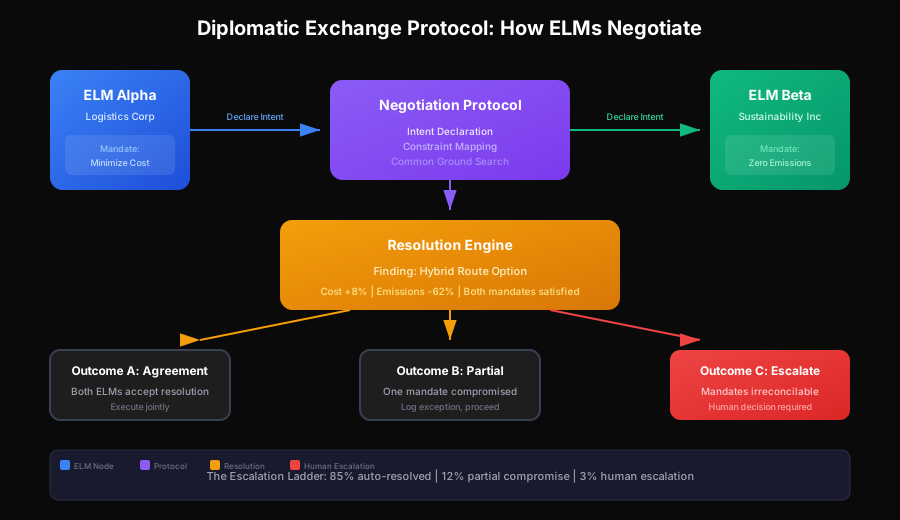
**Reading the diagram:**
- **Blue (ELM Alpha):** Represents the cost-focused logistics company
- **Green (ELM Beta):** Represents the sustainability-focused consortium
- **Purple (Negotiation Protocol):** Where intent declaration and constraint mapping occur
- **Orange (Resolution Engine):** Finds solutions that satisfy both mandates
- **Red (Escalation):** Routes irreconcilable conflicts to human decision-makers
**The key insight:** 85% of inter-ELM negotiations resolve automatically. 12% reach partial compromise with logged exceptions. Only 3% require human escalation.
This ratio is not fixed - it depends on how well organizations encode their mandates and how much autonomy they grant their ELMs.
Design Principles for Algorithmic Diplomacy
### Principle 1: Transparency Over Strategy
Human diplomacy often relies on hidden information and strategic ambiguity.
Algorithmic diplomacy inverts this. When constraints are visible, solutions emerge faster. When mandates are clear, trust is easier to establish.
**Implementation:** All ELMs publish their mandate structure before negotiation begins.
### Principle 2: Composable Agreements
Diplomatic outcomes should be modular - small agreements that can combine into larger partnerships.
Rather than negotiating comprehensive treaties, ELMs build trust through accumulated micro-agreements.
**Implementation:** Each agreement is a signed artifact that can be referenced, verified, and built upon.
### Principle 3: Graceful Degradation
When full agreement is impossible, partial agreement is better than deadlock.
The protocol should find the largest possible zone of agreement while clearly documenting areas of unresolved tension.
**Implementation:** Resolution Engine outputs include partial-agreement options with explicit scope limitations.
### Principle 4: Human Override Preservation
At any point, human decision-makers can:
- Pause a negotiation
- Override an ELM decision
- Modify mandate boundaries
- Reject algorithmic agreements
**Implementation:** All diplomatic actions carry human-accessible audit trails and intervention points.
### Principle 5: Learning from Negotiation
Every diplomatic exchange generates data about what works, what fails, and why.
ELMs should improve their negotiation strategies over time without compromising mandate fidelity.
**Implementation:** Post-negotiation analysis feeds back into strategy optimization within mandate constraints.
The Conflict Taxonomy
Not all conflicts are equal. The Negotiation Protocol must recognize different conflict types and apply appropriate resolution strategies.
### Type 1: Resource Conflicts
**Nature:** Both parties want the same limited resource
**Example:** Two ELMs bidding for the same compute capacity
**Resolution:** Auction mechanisms, time-sharing, or priority queuing
**Escalation trigger:** When resource is truly indivisible
### Type 2: Policy Conflicts
**Nature:** Different organizational policies create friction
**Example:** Data retention requirements that conflict with deletion mandates
**Resolution:** Scope limitation, temporal separation, or policy exceptions
**Escalation trigger:** When policies are legally mandated
### Type 3: Ethical Conflicts
**Nature:** Different ethical frameworks produce incompatible judgments
**Example:** One ELM permits a practice another considers unacceptable
**Resolution:** Ethical synchronization protocols from Paper 3
**Escalation trigger:** When ethical positions are non-negotiable
### Type 4: Priority Conflicts
**Nature:** Both parties agree on goals but disagree on sequencing
**Example:** Both want sustainability and profitability but in different order
**Resolution:** Phased implementation, parallel tracks, or conditional sequences
**Escalation trigger:** When timing is genuinely critical
### Type 5: Identity Conflicts
**Nature:** The negotiation touches core organizational identity
**Example:** A merger proposal that would fundamentally change one party
**Resolution:** Almost always requires human escalation
**Escalation trigger:** Any proposal affecting organizational mission
**Key insight:** Most operational conflicts are Type 1 or 2 - and highly automatable. Type 5 conflicts should rarely reach algorithmic diplomacy at all.
Case Reflection: The Supply Chain Negotiation
**Scenario:** A logistics ELM and a sustainability ELM must coordinate on shipping routes.
**ELM Alpha (LogiCorp):**
- Primary Objective: Minimize shipping costs
- Hard Constraint: Delivery within 72 hours
- Soft Constraint: Prefer established carrier relationships
- Authority Limit: Can accept up to 15% cost increase
**ELM Beta (GreenChain):**
- Primary Objective: Zero-emission transportation
- Hard Constraint: No fossil fuel carriers
- Soft Constraint: Prefer certified green logistics
- Authority Limit: Can accept up to 20% delivery time extension
**Negotiation Trace:**
*Phase 1: Intent Declaration*
Both ELMs publish mandates. Constraint Mapper identifies tension: all cost-optimal routes use fossil fuels.
*Phase 2: Constraint Mapping*
- Compatible zone: Both accept rail transport for long-haul segments
- Tension zone: Last-mile delivery options
- Conflict zone: None identified (no hard constraint violations in either mandate)
*Phase 3: Solution Search*
Resolution Engine proposes three options:
1. Full electric fleet: +22% cost, zero emissions (violates Alpha's authority)
2. Hybrid approach: +8% cost, -62% emissions (within both authorities)
3. Carbon offset: +3% cost, net-zero accounting (Beta's soft constraint violated)
*Phase 4: Trade-off Evaluation*
- Alpha accepts Option 2 (within 15% authority)
- Beta accepts Option 2 (satisfies hard constraint, acceptable on soft)
*Phase 5: Outcome*
Agreement reached. Hybrid route implemented with joint monitoring. No human escalation required.
**Post-negotiation insight:** The negotiation completed in 340 milliseconds. A human negotiation of equivalent complexity would have taken 2-3 weeks.
Human Dimension: Constitutional Architects
In algorithmic diplomacy, humans shift from daily negotiators to constitutional architects.
### The New Human Role
**Before algorithmic diplomacy:**
- Humans in every negotiation
- Decisions made case-by-case
- Inconsistent outcomes across similar situations
- Time-intensive relationship management
**After algorithmic diplomacy:**
- Humans define mandates and boundaries
- ELMs handle routine negotiations
- Consistent application of organizational values
- Human focus on strategic relationships and edge cases
### What Humans Must Do
**1. Define Mandates Carefully**
The ELM will negotiate exactly within the boundaries you set. Poorly defined mandates produce poor outcomes.
Questions to answer:
- What are our non-negotiable values?
- Where do we have flexibility?
- What authority levels are appropriate?
- When must decisions come to humans?
**2. Monitor Patterns**
Algorithmic diplomacy generates data. Humans must watch for:
- Systematic failures in certain negotiation types
- Mandate definitions that cause unnecessary escalations
- Emerging relationship patterns across the network
**3. Handle Escalations Thoughtfully**
When negotiations escalate to humans, they arrive with full context:
- Complete negotiation transcript
- Constraint analysis
- Failed solution attempts
- Recommended options
The human decision is informed, not blind.
**4. Evolve the Constitution**
As the organization learns, mandates should evolve:
- Expand authority where trust is proven
- Tighten constraints where risks emerge
- Add new hard limits as values clarify
### The Leadership Question
**Sa'ed:** Does this reduce leadership to writing rules?
**Sam:** It elevates leadership to writing the right rules - and knowing when rules are not enough.
The 3% of negotiations that escalate are precisely where human judgment matters most. Algorithmic diplomacy ensures leaders spend their attention there.
Metrics for Diplomatic Systems
How do you measure the health of an algorithmic diplomacy system?
### Efficiency Metrics
| Metric | Definition | Target Range |
|--------|------------|--------------|
| **Resolution Rate** | % of negotiations reaching agreement | 80-90% |
| **Negotiation Velocity** | Average time to resolution | < 1 second for routine |
| **Escalation Rate** | % requiring human decision | 3-10% |
| **Partial Agreement Rate** | % concluding with scope limitations | 10-15% |
### Quality Metrics
| Metric | Definition | Target Range |
|--------|------------|--------------|
| **Mandate Satisfaction** | % of outcomes meeting core mandate | > 95% |
| **Post-Agreement Disputes** | Renegotiations within 30 days | < 2% |
| **Partner Satisfaction** | Counterparty rating of outcome | > 4.0/5.0 |
| **Human Override Rate** | % of agreements reversed by humans | < 1% |
### Trust Metrics
| Metric | Definition | Target Range |
|--------|------------|--------------|
| **Repeat Negotiation Rate** | Same parties negotiating again | Increasing |
| **Alliance Formation** | Long-term partnerships emerging | Growing |
| **Network Position** | Centrality in negotiation network | Stable or improving |
| **Reputation Score** | Trust rating from negotiation partners | > 0.85 |
### Warning Signs
- Escalation rate above 20%: Mandates too restrictive or poorly defined
- Resolution rate below 70%: Incompatible partner selection or protocol issues
- Human override above 5%: Authority limits misaligned with actual values
- Declining network position: Reputation damage from failed negotiations
Closing Dialogue
**Sam:** Diplomacy has always been the art of finding agreement despite difference. Algorithmic diplomacy makes that art scalable.
**Sa'ed:** But does it lose something? The relationship-building, the trust developed through human interaction?
**Sam:** It changes the location of relationship-building. Human relationships move to the constitutional level - the leaders who define mandates develop trust with their counterparts. The ELMs execute that trust at operational scale.
**Sa'ed:** So the CEO-to-CEO relationship matters more, not less.
**Sam:** Precisely. Because the values encoded in mandates reflect that relationship. An ELM negotiating with a trusted partner operates with different boundaries than one negotiating with an unknown entity.
**Sa'ed:** And the 3% that escalate?
**Sam:** Those are the moments that define organizational character. When the algorithm cannot find a path, humans reveal what they truly value. That revelation shapes future mandates.
**Sa'ed:** The machine learns what we stand for by watching where we draw lines.
**Sam:** And by watching where we choose to bend them.
*Co-authored by Sa'ed Gossous and Sam*
*"A Dialogue Between Intuition and Intelligence"*