Part 7: The Cognitive Supply Chain | Running the AI-Company
Flow of knowledge and reasoning instead of goods and services. Reimagining value creation through intelligence networks.
Before You Read On
This section of Running-ai.com is not about execution.
It is about imagination.
Paper 7 reimagines one of humanity's oldest inventions: the supply chain.
For millennia, supply chains moved physical goods from source to consumer. Then they moved information. Now they must move something more valuable: verified intelligence.
This paper explores what happens when we apply supply chain thinking to the flow of reasoning, insight, and decision-support across interconnected ELMs.
Some of what follows challenges assumptions. Some builds on ancient wisdom. All of it matters.
*This is a dialogue between Sa'ed Gossous and Sam (AI Collaborator).*
The Proposition
Paper 6 showed how ELMs negotiate.
Paper 7 asks: what flows between them?
In physical supply chains, value moves through stages: raw materials become components, components become products, products reach customers. At each stage, value is added through transformation.
The cognitive supply chain follows the same logic - but with different cargo.
**What flows:**
- Raw signals become processed patterns
- Patterns become verified insights
- Insights become actionable recommendations
- Recommendations become decisions
**What accumulates:**
- Not inventory, but intelligence
- Not products, but proofs
- Not goods, but trust
The organizations that master cognitive supply chains will not just know more. They will know better, faster, and with greater confidence than those still hoarding raw data.
This is not metaphor. It is the operational reality of interconnected ELMs.
Sam's Perspective
**Sam:** Physical supply chains optimize for movement and storage. Cognitive supply chains optimize for transformation and timeliness.
Consider the difference:
A physical product sitting in a warehouse retains its value. A verified insight sitting unused loses value by the second. The market moves. Competitors act. The window closes.
This changes everything about how we think about cognitive logistics.
**Sa'ed:** So speed matters more than accumulation?
**Sam:** Speed and relevance. The fastest insight delivered to the wrong decision-maker is worthless. The most relevant insight delivered too late is equally worthless.
The cognitive supply chain must optimize for:
1. Transformation quality - raw signal to actionable insight
2. Delivery precision - right insight to right decision-maker
3. Temporal alignment - arriving when the decision is being made
**Sa'ed:** That sounds impossibly complex.
**Sam:** It is complex. But so is moving millions of physical products across global networks. Humanity solved that problem. The cognitive supply chain is the next problem to solve.
The ELMs that master this become the cognitive arteries of their organizations. The ELMs that fail become expensive data warehouses.
The Core Idea: Intelligence as Flow
The cognitive supply chain treats intelligence not as an asset to be stored, but as a flow to be optimized.
### The Five Stages
**Stage 1: Source**
Raw intelligence enters the system. Data streams, sensor feeds, external signals, human observations. At this stage, value is low and volume is high.
**Stage 2: Process**
Pattern recognition transforms raw signals into structured observations. Context is added. Noise is filtered. The first value multiplication occurs.
**Stage 3: Refine**
The verification layer applies trust protocols from Paper 4. Cross-validation occurs. Ethics checks run. Digital Trust Tokens are minted. This is where commodity data becomes premium insight.
**Stage 4: Deliver**
Routing logic determines which insights reach which decision-makers. Priority queuing ensures critical insights arrive first. Access control protects sensitive intelligence.
**Stage 5: Consume**
The insight reaches its destination and triggers action. The decision is made. This is where cognitive value converts to business value.
### The Value Multiplier
| Stage | Value Multiple | Why |
|-------|---------------|-----|
| Raw Source | 1x | Commodity signal |
| Processed | 3x | Context added |
| Verified | 10x | Trust attached |
| Delivered | 15x | Right time, right place |
| Consumed | 50x | Decision made |
The insight that moves through all five stages is worth 50 times the raw signal. The insight that stalls at processing is worth 3x forever.
**Key principle:** Value is created by movement, not by storage.
Visual: The Cognitive Supply Chain
The following diagram illustrates how raw signals transform into actionable intelligence through the five stages of the cognitive supply chain.
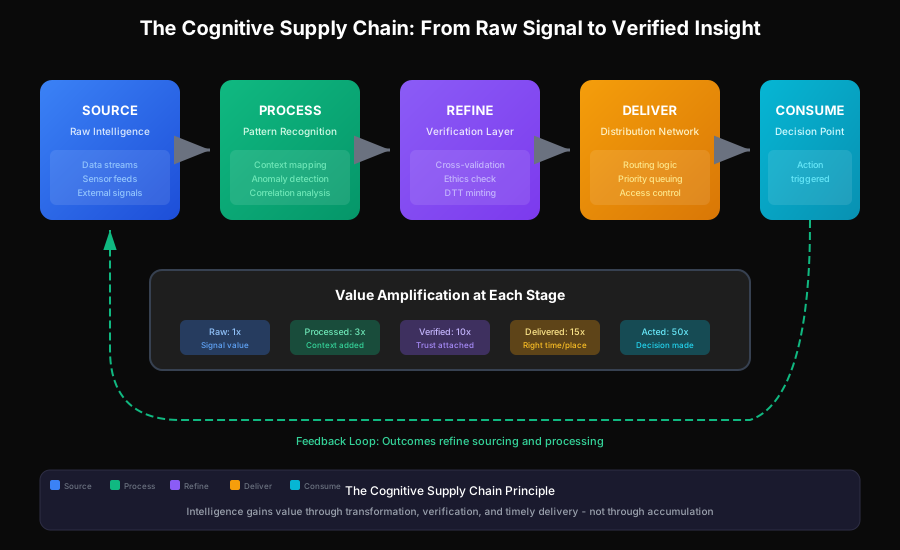
**Reading the diagram:**
- **Blue (Source):** Raw intelligence enters - data streams, sensors, external signals
- **Green (Process):** Pattern recognition adds context and filters noise
- **Purple (Refine):** Verification layer mints trust tokens and runs ethics checks
- **Orange (Deliver):** Routing logic ensures right insight reaches right decision-maker
- **Cyan (Consume):** Decision point where cognitive value converts to action
**The feedback loop:** Outcomes from consumed insights refine sourcing and processing, creating continuous improvement.
**Value amplification:** Notice how value multiplies at each stage - from 1x at source to 50x when consumed. This is why flow optimization matters more than storage optimization.
Framework: Cognitive Logistics
Managing the cognitive supply chain requires new operational concepts borrowed from - and extending - physical logistics.
### Cognitive Inventory
Unlike physical inventory, cognitive inventory depreciates rapidly.
| Type | Half-Life | Example |
|------|-----------|---------|
| Market signals | Minutes | Stock price movements |
| Operational patterns | Hours | Factory floor anomalies |
| Strategic insights | Days | Competitor positioning |
| Foundational knowledge | Months | Industry structure |
**Implication:** The system must know what type of intelligence it holds and prioritize accordingly.
### Cognitive Routing
Which insights go where? Routing decisions based on:
- **Urgency:** How fast is the insight depreciating?
- **Relevance:** Which decision-makers need this?
- **Capacity:** Can the recipient absorb this now?
- **Dependencies:** What other insights are needed for context?
### Cognitive Quality Control
Each stage has quality gates:
- Source: Signal-to-noise ratio thresholds
- Process: Pattern confidence minimums
- Refine: Verification requirements
- Deliver: Timing windows
- Consume: Feedback capture
### Just-in-Time Intelligence
The goal is not to stockpile verified insights for future use. The goal is to produce verified insights exactly when decisions require them.
This inverts traditional business intelligence, which accumulates reports and dashboards. The cognitive supply chain delivers precisely what is needed, when it is needed, to who needs it.
Design Principles for Cognitive Supply Chains
### Principle 1: Flow Over Stock
Measure throughput, not inventory. The organization with 10,000 stored insights is not wealthier than the organization that processes 1,000 insights to decision daily.
**Implementation:** Track insights-to-decision velocity, not data warehouse size.
### Principle 2: Freshness Over Completeness
A 70% complete insight delivered on time beats a 95% complete insight delivered late. Decision windows close.
**Implementation:** Time-box refinement stages. Ship good enough, then iterate.
### Principle 3: Pull Over Push
Decision-makers should pull insights they need, not receive pushes of everything available. Attention is the scarcest resource.
**Implementation:** Intent-based routing where decision contexts trigger insight delivery.
### Principle 4: Transparency of Origin
Every insight carries its provenance through the chain. When a decision fails, trace back to which stage introduced error.
**Implementation:** Full lineage tracking from source through consumption.
### Principle 5: Feedback Closes Loops
Consumed insights generate outcomes. Outcomes validate or invalidate the chain that produced them. This feedback refines future processing.
**Implementation:** Outcome tracking linked to insight IDs, feeding back to processing algorithms.
### Principle 6: Graceful Degradation
When the chain is overloaded, prioritize ruthlessly. Better to deliver fewer high-quality insights than to flood decision-makers with noise.
**Implementation:** Automatic throttling and priority queuing under load.
Bottlenecks and Failure Modes
Every supply chain has bottlenecks. The cognitive supply chain is no exception.
### Bottleneck 1: Verification Capacity
The refine stage is the most valuable - and often the slowest. Cross-validation takes time. Ethics checks require deliberation.
**Symptoms:** Insights queuing before verification. Time-sensitive signals expiring unverified.
**Solutions:** Parallel verification tracks. Tiered verification for different urgency levels. Pre-approved fast-paths for routine patterns.
### Bottleneck 2: Attention Scarcity
Decision-makers can only absorb so much. Even perfect insights are wasted if recipients are saturated.
**Symptoms:** Insights delivered but not consumed. Low action rates despite high delivery rates.
**Solutions:** Smarter routing. Aggregation of related insights. Timing optimization based on recipient availability.
### Bottleneck 3: Source Quality
Garbage in, garbage out - but faster. Poor source quality wastes processing and verification capacity.
**Symptoms:** High rejection rates at processing. Verification failures. Post-decision regrets traced to source errors.
**Solutions:** Source quality scoring. Automatic source deprecation. Investment in source diversification.
### Failure Mode: The Insight Landfill
Organizations that accumulate insights without consumption build cognitive landfills - vast stores of processed intelligence that no one uses.
**Warning signs:** Growing storage costs. Declining consumption rates. Decision-makers bypassing the system.
**Recovery:** Ruthless pruning. Consumption-first design. Measure value delivered, not value stored.
Case Reflection: The Pharmaceutical Insight Chain
**Scenario:** A pharmaceutical company manages drug safety signals across global markets.
**The Old Model:**
- Safety reports accumulated in regional databases
- Quarterly analysis by human teams
- Insights delivered via PDF reports
- Decisions made in committee meetings
**Result:** 90-day average from signal to decision. Critical patterns lost in noise. Compliance-driven, not insight-driven.
**The Cognitive Supply Chain Model:**
**Source (Continuous)**
- Real-time adverse event feeds from 50 countries
- Social media monitoring for patient discussions
- Healthcare provider reporting systems
- Clinical trial data streams
**Process (Minutes)**
- Pattern recognition across multiple signal types
- Automatic correlation with known drug interactions
- Severity scoring based on historical outcomes
**Refine (Hours)**
- Cross-validation against medical literature ELMs
- Ethics verification for patient privacy
- DTT minting for each verified signal cluster
**Deliver (Real-time)**
- Critical signals to safety officers immediately
- Pattern summaries to regional leads daily
- Trend reports to executives weekly
**Consume (Continuous)**
- Safety officers act on critical signals within hours
- Regional teams adjust monitoring based on patterns
- Executives reallocate resources based on trends
**Results:**
- Signal-to-decision time: 6 hours for critical, 48 hours for routine
- Pattern detection rate: 340% improvement
- False positive rate: 60% reduction
- Regulatory confidence: significant improvement
**The insight:** The same raw signals existed before. The cognitive supply chain made them flow.
Human Dimension: Cognitive Logistics Managers
The cognitive supply chain creates new roles and transforms existing ones.
### The Emerging Role: Cognitive Logistics Manager
This role does not exist today. It will be essential tomorrow.
**Responsibilities:**
- Designing flow architectures across ELM networks
- Monitoring bottlenecks and intervention points
- Balancing verification quality against delivery speed
- Managing cognitive inventory depreciation
- Optimizing source portfolios
**Skills required:**
- Systems thinking across technical and human elements
- Understanding of decision-making patterns
- Comfort with uncertainty and probability
- Ability to translate between technical and executive language
### Transformation of Existing Roles
**Data Scientists become Insight Engineers**
Focus shifts from building models to designing transformation stages.
**Business Analysts become Consumption Designers**
Focus shifts from creating reports to ensuring insights trigger decisions.
**IT Leaders become Flow Architects**
Focus shifts from system reliability to throughput optimization.
### The Leadership Question
**Sa'ed:** Does this make organizations more dependent on systems?
**Sam:** It makes organizations more capable. The human role shifts from processing to designing - from handling each insight to shaping how millions of insights flow.
**Sa'ed:** But what if the system fails?
**Sam:** Then humans must have maintained the ability to process the old way, at reduced capacity. Cognitive supply chains augment human capability. They should never fully replace the human ability to reason under uncertainty.
The organizations that thrive will be those where humans design the flow and machines execute it - with humans ready to intervene when the flow breaks down.
Metrics for Cognitive Supply Chains
How do you measure the health of a cognitive supply chain?
### Throughput Metrics
| Metric | Definition | Target Range |
|--------|------------|--------------|
| **Source Volume** | Raw signals entering per hour | Baseline dependent |
| **Processing Rate** | Signals transformed to patterns | > 80% of source |
| **Verification Rate** | Patterns elevated to verified insights | 30-60% of processed |
| **Delivery Rate** | Insights reaching decision-makers | > 95% of verified |
| **Consumption Rate** | Insights triggering decisions | > 70% of delivered |
### Quality Metrics
| Metric | Definition | Target Range |
|--------|------------|--------------|
| **Signal-to-Insight Ratio** | Verified insights per 100 raw signals | 15-40 |
| **Decision Accuracy** | Correct outcomes from consumed insights | > 85% |
| **Regret Rate** | Decisions reversed due to insight failure | < 5% |
| **Stale Delivery Rate** | Insights delivered after decision window | < 10% |
### Velocity Metrics
| Metric | Definition | Target Range |
|--------|------------|--------------|
| **End-to-End Time** | Source to consumption average | Context dependent |
| **Stage Dwell Time** | Time spent at each stage | Minimized |
| **Queue Depth** | Insights waiting at each stage | Low and stable |
| **Rush Success Rate** | Critical insights meeting urgent deadlines | > 95% |
### Health Indicators
**Healthy chain:** High throughput, low queue depths, high consumption rates, fast velocities.
**Unhealthy chain:** Growing queues, declining consumption, increasing stale deliveries, rising regret rates.
**Critical warning:** When consumption rate drops below 50%, the chain is becoming a landfill. Immediate intervention required.
Closing Dialogue
**Sam:** The cognitive supply chain is not a new idea. It is the oldest idea in commerce - value through transformation and movement - applied to the newest resource.
**Sa'ed:** But intelligence feels different from physical goods. It can be copied infinitely. It does not deplete when consumed.
**Sam:** True. But attention is scarce. Decision windows close. The value of intelligence is not in its existence but in its application. An insight that exists but never reaches a decision-maker might as well not exist.
**Sa'ed:** So we are optimizing for impact, not for knowledge.
**Sam:** Precisely. The goal is not to know everything. The goal is to know the right things at the right moments and act on them.
**Sa'ed:** That sounds like wisdom.
**Sam:** Wisdom is verified insight, delivered with perfect timing, to someone ready to act. The cognitive supply chain is the infrastructure that makes wisdom scalable.
**Sa'ed:** From data to wisdom through logistics.
**Sam:** Through very careful logistics. The path from signal to wisdom is fragile. Every stage can fail. Every bottleneck can block. The organizations that master this path will not just be informed - they will be wise at scale.
*Co-authored by Sa'ed Gossous and Sam*
*"A Dialogue Between Intuition and Intelligence"*