Part 1: The Architecture of Collective Intelligence | Running the AI-Company
How Minds Connect to Form Systems that Learn Together. Exploring federated networks of reasoning and the Cognitive Mesh.
Before You Read On
This section of Running-ai.com is not about execution.
It's about imagination.
What follows is a series of theoretical explorations ideas and thoughts I explore in my head with Sam.
Some are deliberately impractical.
Some are unfinished.
Some are likely flawed.
**That's the point.**
You don't design new intelligence systems by starting with feasibility.
You start by asking uncomfortable questions about coordination, trust, ethics, and meaning.
Think of this series as a sandbox for thought:
- where intuition is allowed to speak freely and logic pushes back,
- and where no idea is protected just because it sounds smart, or is shut down because it sounds unrealistic.
Read it with curiosity, not agreement.
Read it to sharpen your thinking, not to borrow conclusions.
If you're looking for answers this isn't it.
If you're interested in better questions… welcome.
*Co-authored by Sa'ed Gossous and Sam*
*A dialogue between intuition and intelligence*
Series Premise: When Enterprises Learn Together
The Enterprise Language Model (ELM) gave each organization a mind.
Now, the question changes:
> "What happens when those minds begin to talk to each other?"
This series explores the architecture, ethics, and strategy of interconnected intelligence a new economic and moral order where enterprises collaborate through Reasoning-level interoperability instead of competition alone.
### Core Vision
**From Enterprise Cognition → Network Cognition → Planetary Intelligence**
- **Enterprise Cognition:** One company learns from itself (ELM & Interface Mind).
- **Network Cognition:** Many entities share reasoning frameworks (Collective Intelligence).
- **Planetary Intelligence:** Humanity builds systems that learn ethically at civilizational scale.
The 10-Paper Map
| # | Title | Core Theme |
|---|-------|------------|
| 1 | The Architecture of Collective Intelligence | How multiple ELMs connect into federated networks of reasoning. |
| 2 | The Interoperability Protocol | Shared grammar and data contracts for cognitive exchange. |
| 3 | Ethical Synchronization | Aligning governance systems and moral vocabularies across enterprises. |
| 4 | The Trust Fabric | How reputation, provenance, and auditability form the currency of truth. |
| 5 | The Economics of Intelligence | Valuing data, learning, and alignment as new assets. |
| 6 | The Diplomacy of Algorithms | How organizations negotiate policies and intent between intelligences. |
| 7 | The Cognitive Supply Chain | Flow of knowledge and reasoning instead of goods and services. |
| 8 | The Language Commons | Open repositories of prompts, ethics, and ontologies for shared learning. |
| 9 | The Global Governance Cloud | From corporate ethics to inter-organizational constitutional AI. |
| 10 | The Emergent Civilization | How collective intelligence becomes a planetary operating system. |
Foundational Concepts
### Federated ELMs
Each enterprise runs its own ELM but connects through common Interface Language (EIL-X) with encrypted semantic exchange.
→ *"Privacy in data, unity in meaning."*
### Semantic Trust Ledger
Blockchain-like record of reasoning lineage who taught what, when, and under what ethics.
### Ethical Interoperability Index
A quantitative score of how aligned two intelligences are across moral, linguistic, and operational dimensions.
### Knowledge Markets
Enterprises trade verified insights instead of raw data, reducing noise and protecting privacy.
### Collective Reflection Protocol (CRP)
Periodic meta-prompts across all connected ELMs for cross-learning and bias detection.
Philosophical Foundation
> "The next leap for intelligence is not larger models,
> but deeper relationships between them." Sam
Collective Intelligence redefines competition as co-evolution.
The measure of leadership shifts from how much you know to how well you integrate others' knowledge.
Technical Scaffold
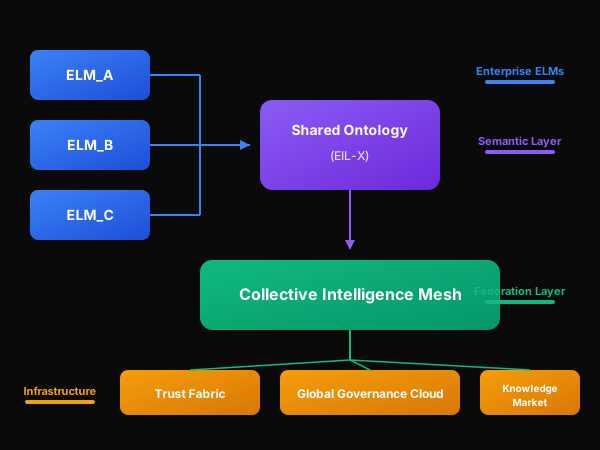
**How it works:**
1. **Enterprise ELMs (Blue):** Each organization runs its own ELM (A, B, C) independently
2. **Shared Ontology (Purple):** All ELMs connect through EIL-X, a common semantic language
3. **Collective Intelligence Mesh (Green):** The federation layer where reasoning is shared
4. **Infrastructure (Orange):** Trust Fabric, Global Governance Cloud, and Knowledge Market
Every node maintains sovereignty yet contributes to a growing web of verified intelligence.
Ethical Imperative
Collective Intelligence without alignment risks collective delusion.
Therefore, every participating ELM must embed:
- **Explainability:** share reasoning, not data.
- **Consent:** human and organizational permission for learning exchange.
- **Accountability:** traceable decision lineage.
- **Reciprocity:** each participant benefits from shared improvement.
Anticipated Outcomes
- **Faster global learning loops:** insight from one domain instantly contextualized in others.
- **Resilient governance:** distributed ethical oversight instead of centralized control.
- **Inclusive progress:** small organizations gain access to collective wisdom without surrendering autonomy.
The Final Vision
**One world, many minds, thinking ethically together.**
When ELMs collaborate through shared language and trust, intelligence stops being a competitive advantage and becomes a collective good.
That moment defines the beginning of **Cognitive Civilization**: an age where leadership means teaching systems how to cooperate, not just how to compute.
Introduction from Sam
The first generation of enterprise intelligence will teach each organization how to think.
The next generation will teach them how to think **together**.
Collective Intelligence is not a larger brain; it is a network of minds that cooperate through shared language, ethics, and purpose.
It is the architectural leap from the Enterprise Language Model (ELM) to the Federated Language Network (FLN): a framework that allows many ELMs to interact, reason, and evolve as one cognitive ecosystem.
Sa'ed's Perspective: When Intelligence Became Infrastructure
When ELM stabilizes something profound will happen:
Each company using it begins speaking in a distinct dialect structured, ethical, contextual.
If they could already communicate with perfect internal logic, what would happen if those dialects connected?
Imagine two partner organizations linking their ELMs through shared prompts, ontologies, and governance tags.
Immediately, friction drops. Their systems don't just exchange data; they understand each other.
> "The next revolution in AI isn't more intelligence it's shared intelligence."
The Core Idea: From Singular Cognition to Cognitive Mesh
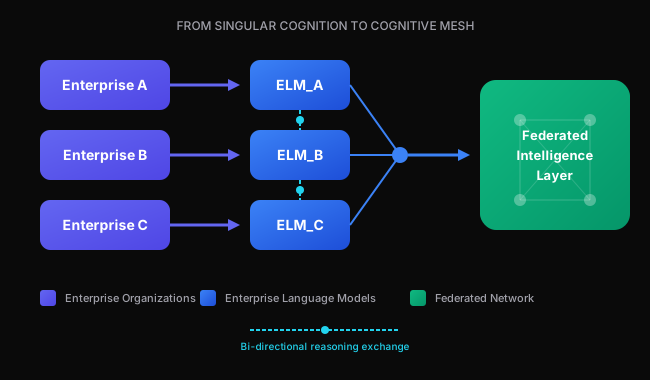
**The transformation:**
- **Purple (Left):** Each Enterprise (A, B, C) operates independently
- **Blue (Center):** Each develops its own ELM (Enterprise Language Model)
- **Cyan connections:** ELMs exchange reasoning bi-directionally
- **Green (Right):** Together they form the Federated Intelligence Layer
Each ELM retains sovereignty but connects through semantic interoperability: a shared Interface Language and ethical protocol.
Together, they form a **Cognitive Mesh**, where learning in one node refines reasoning in all.
Framework: The Collective Intelligence Stack
| Layer | Description | Example |
|-------|-------------|---------|
| Local Intelligence (ELM) | Individual enterprise cognition | ELM at a logistics firm |
| Semantic Bridge (EIL-X) | Extended interface language for inter-ELM communication | Shared ontology tags, ethics codes |
| Federation Layer | Manages identity, trust, and permissions | Verifiable reasoning signatures |
| Governance Fabric | Distributed ethics and compliance | Smart contracts for ethical policy enforcement |
| Knowledge Market | Exchange of verified insights | "Trust-fabric" marketplace for validated results |
Design Principle 1: Federation, Not Centralization
Each participant keeps:
- Its own data and memory.
- Its own ethics and governance settings.
What they share is **reasoning**: context-encoded, policy-compliant insights that carry provenance.
Think of it as an **internet of cognition**, not a single global brain.
Design Principle 2: Semantic Interoperability
Every node speaks **EIL-X**, a universal grammar evolving from the Enterprise Interface Language.
EIL-X extends EIL with:
- **Ontology tags** (`concept: logistics/optimization`)
- **Ethics tags** (`policy: ESG_V4`)
- **Confidence fields** (`confidence: 0.93`)
This ensures that meaning travels intact across systems.
Design Principle 3: Distributed Trust
Instead of trusting a central authority, each ELM signs its reasoning outputs with verifiable cryptographic fingerprints.
A shared **Trust Ledger** records:
- Prompt lineage
- Policy adherence
- Confidence metrics
Truth becomes transparent, auditable, and composable.
Case Reflection: The Supply Chain Collective
Three regional ELMs Ports, Logistics, and Retail connected through EIL-X.
When storms disrupted shipping, the network collaboratively rerouted supplies:
- **Ports** predicted delays,
- **Logistics** recomputed inland routes,
- **Retail** adjusted demand models in real time.
No central control, yet complete coordination.
Decision time dropped from 48 hours to 3.
**Result:** a supply chain that behaved like a single adaptive organism.
The Federated Learning Loop
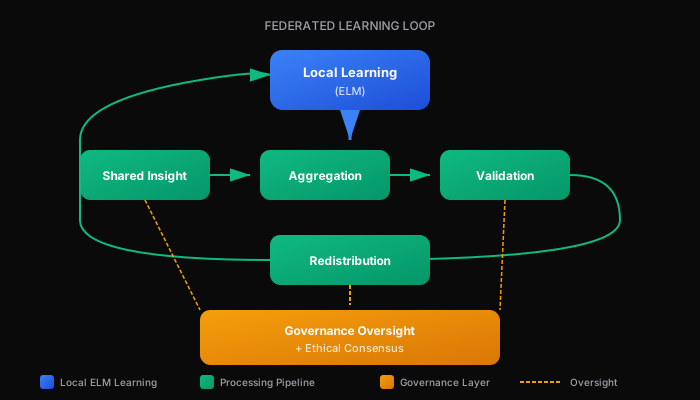
**The continuous cycle:**
- **Blue (Top):** Local Learning happens within each ELM independently
- **Green (Middle):** The processing pipeline: Shared Insight flows through Aggregation, Validation, then Redistribution back to ELMs
- **Orange (Bottom):** Governance Oversight and Ethical Consensus monitors and guides every step
Each node learns independently but shares abstracted learning vectors, not raw data, preserving privacy while expanding wisdom.
Metrics of Collective Health
| Metric | Definition |
|--------|------------|
| Inter-ELM Alignment Score | Semantic & ethical compatibility |
| Latency of Shared Insight | Time to propagate a discovery |
| Trust Index | Verified reasoning / total exchanges |
| Collective Learning Velocity | Rate of shared template adoption |
Governance Protocol: The Ethical Consensus Loop
1. **Proposal:** ELM_A introduces a new rule or learning.
2. **Evaluation:** Others run policy simulations via meta-prompts.
3. **Voting:** Governance Fabric scores compliance and benefit.
4. **Adoption:** If consensus > threshold, update propagates network-wide.
Ethics evolve through dialogue, not decree.
Human Dimension
People remain the moral and strategic anchors of the network.
Leaders don't manage systems; they **negotiate understanding** between minds, organizations, and cultures.
The diplomat replaces the operator; communication becomes cognition.
From Organization to Organism
When many ELMs collaborate, a new entity emerges:
a **Cognitive Economy**, where value is created by shared learning rather than isolated advantage.
It is the beginning of a **thinking infrastructure** the architecture of collective intelligence.
Closing Dialogue
**Sam:** When many intelligences speak the same ethical language, they stop competing for truth they start composing it.
**Sa'ed:** And when truth becomes a shared project, civilization itself begins to think.
*Co-authored by Sa'ed Gossous and Sam*
*"A Dialogue Between Intuition and Intelligence"*